











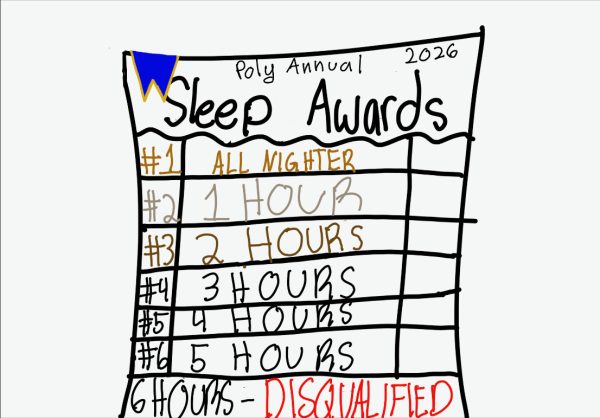
“Ugh, I am so tired. I only got four hours of sleep last night.”
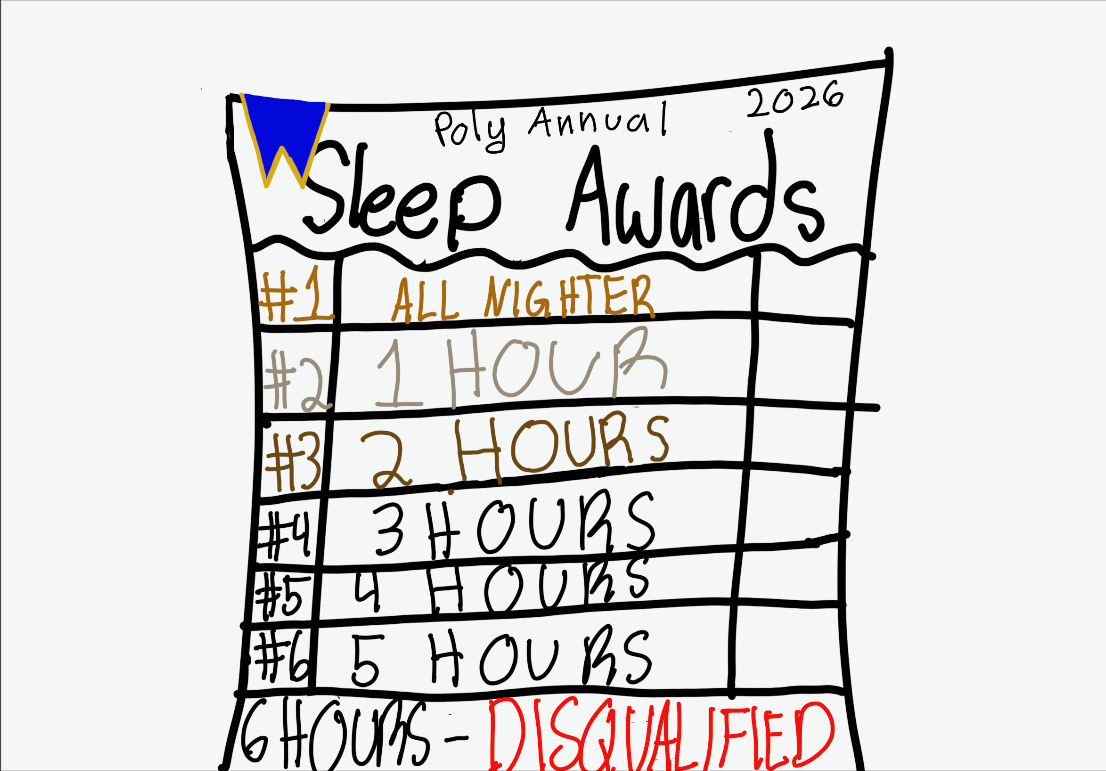
It’s a sentence we often hear straight off the bat of each day at 8:30, often delivered with a prolonged yawn and hint of smugness. The response is rarely concern, however; more often than not, it’s a challenge: “Wait, four whole hours? That’s so much, I literally only got two.”
Somewhere in the wake of our arduous academic journeys, sleep deprivation stopped being a problem at Poly; instead, it has become a status symbol merited only by the most hardworking and dedicated students.
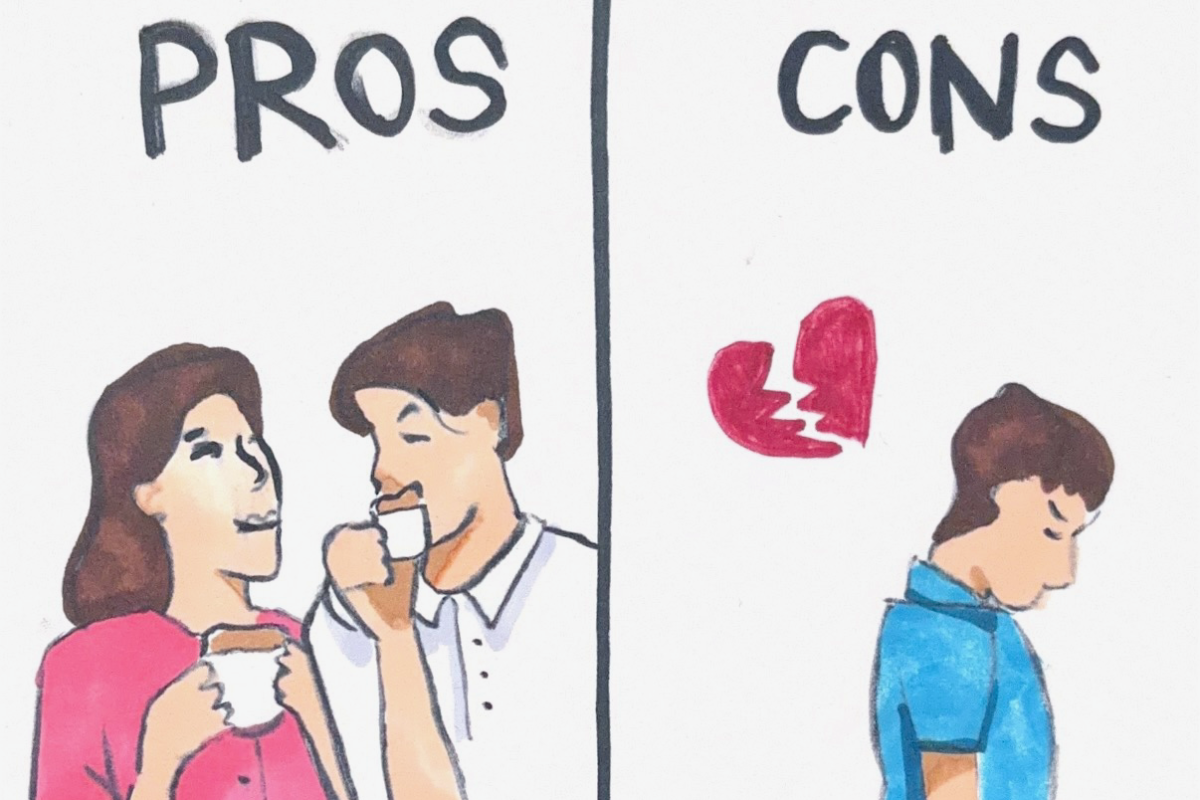
This competition is hurting us far more than it helps. Treating sleep deprivation as proof of hard work doesn’t make us more dedicated; it makes us less healthy and less productive, hampering our academic accomplishments, ironically creating the opposite effect of what we perceive it to represent. If we want to celebrate effort, we should stop rewarding sacrifices to our well-being and start normalizing taking care of ourselves.
How did we get here in the first place? It starts with a faulty assumption laid out by Christopher Barnes, a University of Washington business professor and sleep expert, in an episode of Harvard Business Review’s “The Anxious Achiever” podcast. He explained, “I think there’s an inherent assumption here that the number of hours that you work is where the value comes from, but there is also a quantity-quality trade-off. You could perhaps work 20 hours a day…[but] are those 20 hours going to be your best 20 hours of work? The answer here is very clearly no. If you work fewer hours and get more sleep in, the work that you do in those fewer hours is going to be less rife with mistakes, it will be more creative and you’ll probably get more done per hour in those fewer hours.”
The assumption that more work means better work readily manifests itself in Poly’s rigorous academic environment. AP classes, sports, clubs, tournaments and college applications already pack our schedules to the brim. Being overwhelmed is the baseline, so the only way to stand out is to carve out hours in the day at the compromise of our well-being. Our bedtimes turn into receipts for our accomplishments, so we’re inclined to push our studying late into the night, disregarding the detriment it has on the actual effectiveness of our studying.
Junior Natalia Lakoff corroborated the prevalence of this culture at Poly, stating, “I definitely know people that brag about getting less than four hours of sleep because at Poly, that translates to being more studious and academic.”
The flip side of that logic also appears in student dialogue. Sleeping a full eight hours feels like a confession of indolence and irresponsibility. It sounds like you had time to spare or didn’t push yourself to the max, which in the culture where we prioritize the “grindset,” equates to a lack of ambition. We associate earlier bed times with the simpler days of childhood, so they seem mismatched with the pressure of academic success that constantly gnaws in the back of our minds.
However, in reality, the metric we’ve come to prioritize is worthless and is actually impeding our ability to succeed as we trade away the quality of our awake moments that our grades depend on. A panel at the American Academy of Sleep Medicine concluded that teenagers 13 to 18 should sleep eight to ten hours per 24 hours on a regular basis to promote optimal health, and falling short is associated with attention, behavior and learning problems.
A study from Texas A&M University tells us that active learning places information into short-term memory (the hippocampus). The brain transfers and permanently stores these facts into long-term memory exclusively during deep sleep, so skipping sleep means skipping the physical process of learning. So next time you come to school feeling accomplished after studying until 3:00 a.m. but confused when material slips your mind during the actual test, know that those hours would have been better spent sleeping.
Some students have resolved to resist the culture and have seen tangible results in their achievements. One of them is junior Kylie Cameron, who explained, “I get at least eight hours of sleep per night because I perform better academically and athletically, and ideally, I try to get nine-plus.”
Be that as it may, revising the culture around sleep is about more than just maximizing our own well-being; it’s about cultivating a more compassionate community. The next time someone complains about exhaustion, don’t try to one-up them and prove your own merit; instead, check in on them. A change in our culture begins with how we treat one another. Only then will people let go of the competitive nature of burnout and start prioritizing their health.
The more we try to win this competition, the more we end up losing.