






I think we should become as comfortable discussing the use of AI in the classroom as we’ve become with using GPS. Fifty years ago, navigating uncharted territory meant reading paper maps and inevitably getting lost. Today, we leave those decisions to a satellite navigation system. But just because we use GPS doesn’t mean we can’t know how to get around or drive without it.
In my view (and as it turns out, several students), using ChatGPT to explain a math mistake would sound like good study practice, yet asking it to evaluate an English essay thesis would raise suspicions about originality. I was more willing to call the first student resourceful but question whether the second was independently thinking. But if both students sought feedback on work they had already attempted, what justified my different reactions?
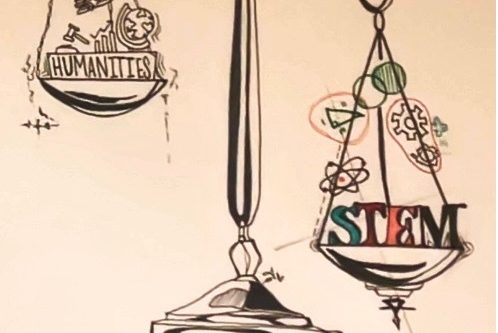
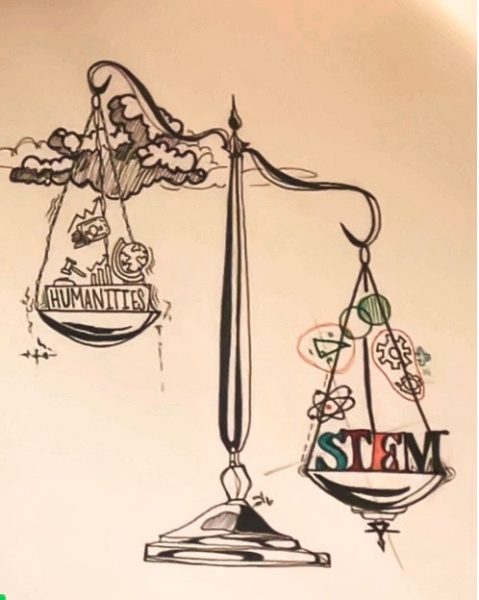
Sophomore Lina Haaga explained the disparity between our perception of using AI in STEM versus the humanities: “I have often noticed that AI is viewed as an acceptable study tool… in STEM classes, while using AI in any measure for English is considered unacceptable.”
Haaga attributed this divide to the belief that English requires original expression whereas STEM prizes correct answers. Although one student’s observation cannot represent a schoolwide stigma, it raises an overlooked question: are we judging what AI does, or simply where it appears?
I think the deeper problem is the moral judgment we assign to AI use. We focus on determining whether someone used it before asking how or why they used it. Because asking AI for help in English writing feels like a wrongdoing, students may hesitate to ask teachers what responsible assistance looks like.
Initially, I suspected faculty interviews would go something like this: STEM = AI ingenuity, yay! Humanities = AI slop, blasphemy! Instead, my conversations overturned my assumptions.
Upper School Math Teacher Michael Taylor uses AI to build interactive online tools. His “problem of the day” activity uses AI to generate problems, assess students, and offer hints without handing over solutions. “I view AI as a force multiplier,” he noted. “I actually increase what I’m doing for students because now I can use my time so much more efficiently and I can do things that before would have been completely unfeasible.”
Yet Taylor draws a distinction about using AI when learning foundational skills. “If you’re trying to learn how to code, you probably shouldn’t be using AI to code,” he said.
Like writing an English essay, creating code from scratch develops fundamental skills, but this doesn’t mean we shouldn’t use AI to fact-check or correct errors in coding.
Upper School English Teacher Laura Holmgren similarly opposes using AI to generate essays or ideas before learning to write independently. However, she assigns an exercise to her students that asks them to compare AI-generated writing feedback with their own. “[Students are] not going to use it to write, we’re going to use it to evaluate,” she said.
When I asked Holmgren whether requesting AI to generate counterarguments to one’s thesis differs from brainstorming with a peer, she replied, “I don’t think there is much of a difference.”
Still, Holmgren clarified that AI is useful once students have the understanding to evaluate its suggestions. “But, if you’re skilled at writing the prompt and you have knowledge you have, the AI may be better than your peer,” she said.
Originality isn’t necessarily the absence of assistance, but the choices we make on how we use that assistance. Educators in both STEM and the humanities ultimately have the same goal of cultivating students’ ability to think for themselves, so why do we keep imagining math and English as opposite sides of a spectrum?
Based on student interviews, writing feels personal: we treat language and our writing voice as evidence of who we are. We think that AI explaining equations is just a calculator, but the moment it adopts a voice, it invades ours. However, this belief assumes that using AI in English-related assignments means the bot writes an entire paper. In reality, if we learn to create effective prompts, we can use AI to simply provide feedback on an existing piece of work. We must not see AI as a replacement for our voice, but rather as a form of “tuning.” Therefore, AI can bring valuable input in either subject when used ethically.
Poly’s broader conversations seem to reinforce bias. Our academic integrity policy specifically prohibits AI-generated research or writing without teacher permission, yet don’t address STEM problems in the same way. Upper School Media & Educational Technology Specialist Karen Barton acknowledged this disproportionate focus on AI-written papers. “Globally, I think the focus has been on writing,” she stated. “I can see how some may see that as bias, though using AI to generate math problems for practice is different than using AI to critique writing that will be graded.”
Our selective discomfort has consequences as students who fear stigma may avoid AI’s help or use it without guidance, impeding the very AI literacy that schools must cultivate.
Now, I don’t suggest we fully surrender ourselves to AI. If anything, my interview with Assistant Head of School Trixie Sabundayo made me more determined to protect AI use. She saw no fundamental divide between developing an English thesis and solving a math problem. “They both rely on your thinking,” she said.
She stressed that progress in AI reform begins with dialogue. “The core principle of having open and honest conversations about AI is the first step,” Sabundayo said. Those conversations begin with one question across all departments: does AI help students develop a skill, or perform it for them? Boundaries may differ, but teachers should explain them through the learning each assignment is designed to protect, and students should ask WHAT the purpose of the assignment serves, to preserve motivation and integrity.
Schools can, and should, discuss how and when to use AI. Effectiveness relies on confrontation; the future of AI in education doesn’t start with deciding which subject gets a free pass, it starts with examining assumptions keeping us from making that distinction fairly. Talks about policy reformation or teaching kids to use AI ethically won’t happen if the stigma around using it continues to persist.
The future of AI in education is malleable. It starts not with changing our rules, but with changing our minds.