

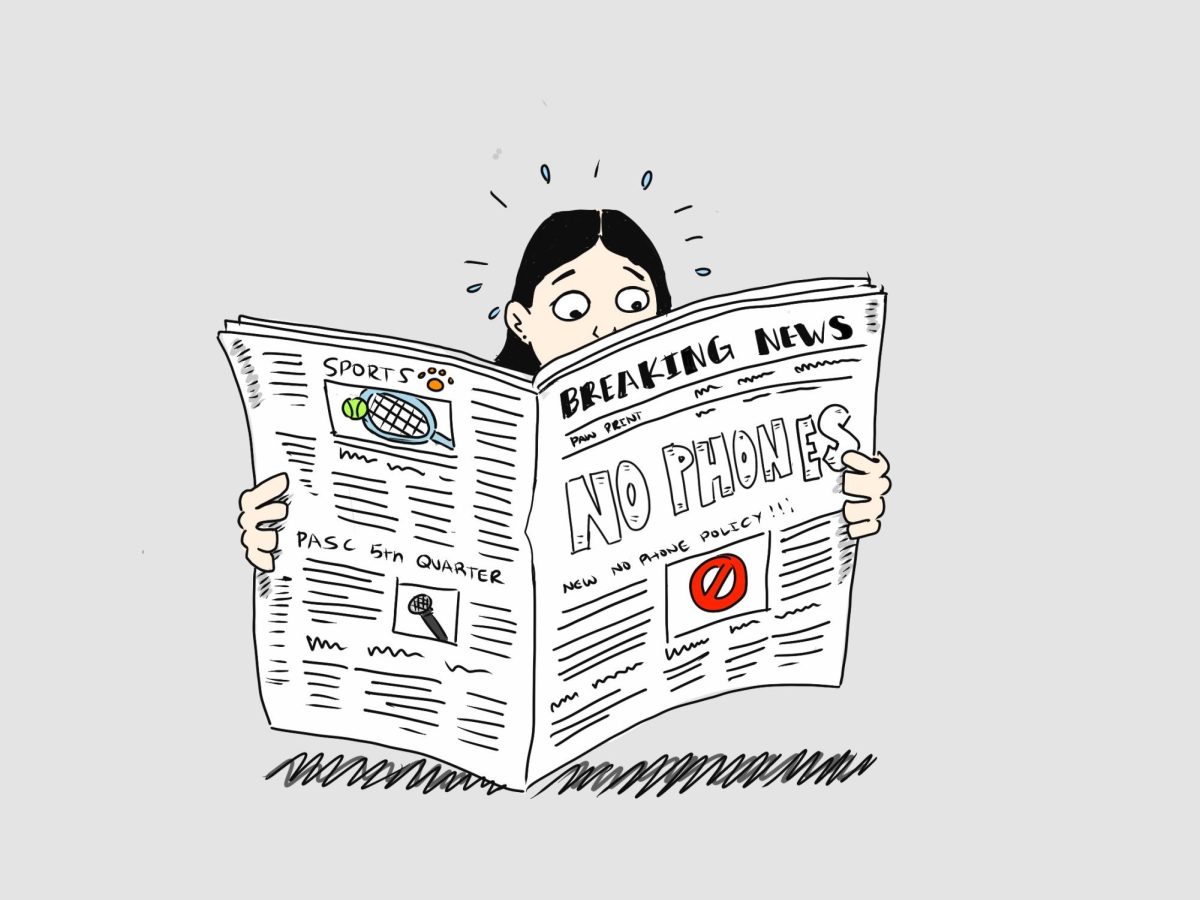














This school year, Poly expanded cell phone restrictions from the Lower and Middle Schools to the Upper School campus. Students are no longer allowed to use cell phones, smartwatches or AI-enabled glasses during school hours. This is a change from prior years, when students were allowed to use phones in between classes, during lunch and during free periods, and teachers were responsible for establishing their own policies for phone use in their classrooms.
Although the phone-free policy is new to Poly’s Upper School campus this year, it is not unique. In a 2025 survey conducted by USC, 78.4% of students nationwide reported having a “no cell phone” rule or ban. Additionally, a 2026 working paper published by the National Bureau of Economic Research found that phone bans in schools significantly improved student test scores, reduced unexcused absences and improved overall student engagement—but only after several years of implementation. This school year, California’s Phone-Free School Act is also going into effect, requiring all California public and charter schools to limit or prohibit smartphones.
Poly’s new “Cell Phone Expectations at a Glance” document states, “By putting devices away, we hope students will have more opportunities to talk, collaborate, participate and build the relationships that make Poly a strong community.”
Conversations amongst the Poly community regarding the influence of phones began several years ago. In October 2024, Dino Ambrosi, founder of Project Reboot, spoke to the Upper School community about screen addiction and the importance of fostering healthier relationships with technology. Ambrosi returned in 2025 to reinstill these values and share personal anecdotes regarding device use.
Ambrosi does not advocate for phone bans but instead encourages schools to teach students how to use phones responsibly. Last year, he said in an interview, “My hope is that Polytechnic School can be one of the first schools to prove that there’s a better way to approach the problem, and that’s by bringing students into the conversation and focusing on creating this cultural shift among the student body that’s led by the students, where we don’t say it’s all bad and we shouldn’t use it, but we have more honest, transparent conversations about the ways in which it is affecting us, and we work together.”
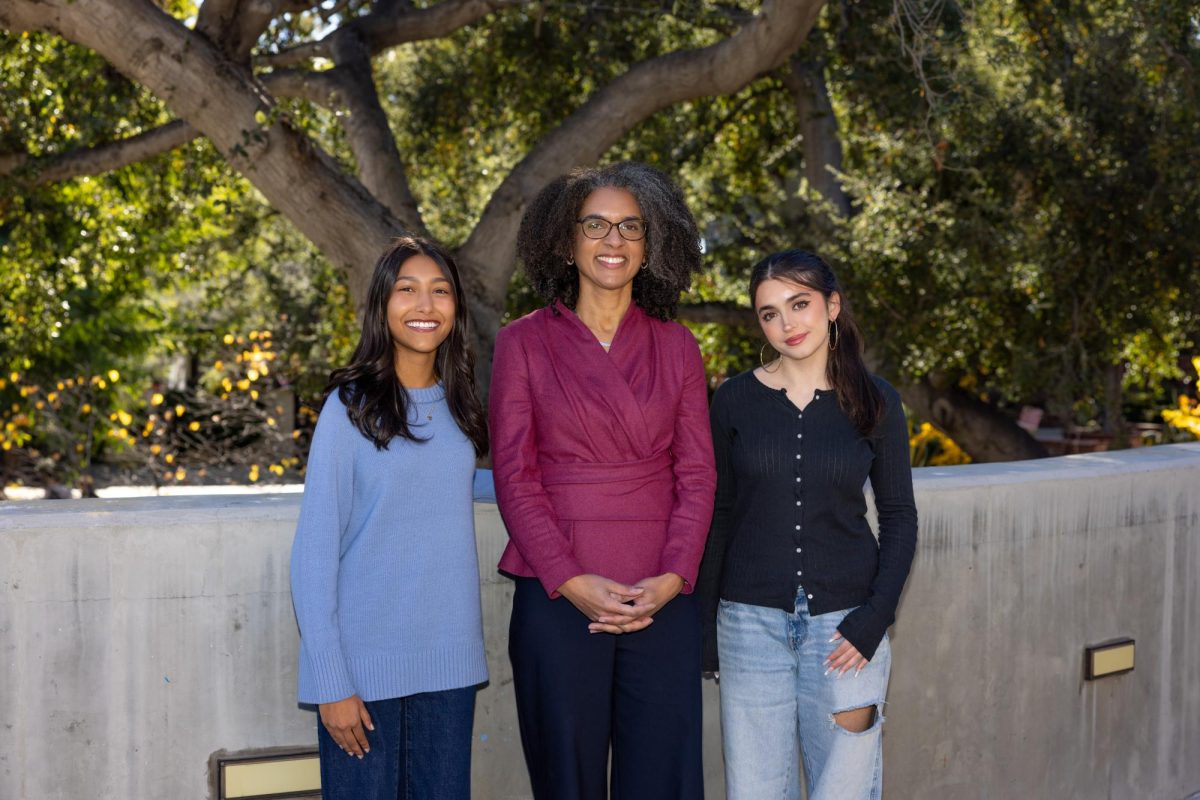
Discussions for the Upper School phone policy itself began last year, with a faculty committee tasked with researching and proposing a policy. The committee was headed by K-12 World Languages Chair Evelyn Barrientos and was divided into three subcommittees: a faculty group consisting of Barrientos, Upper School Counselor Andrea Fleetham, 6-12 English Department Chair Serra Leroy, Performing Arts Teacher Samuel Robinson, and former Upper School Computer Science Department Chair and Physics Teacher Richard White, who has since retired; a student group composed of each class president as well as then-ASB president Alex Chui ‘26; and a parent group with one parent from each grade level.
The faculty on the committee also visited local independent schools, such as Flintridge Preparatory School and Sequoyah School, to observe how their phone restrictions were affecting student interactions. In addition to looking outward, the committee gathered input from within Poly through surveys of students, parents and faculty. Together, these perspectives helped the committee consider how a new policy could better align the Upper School with the Middle School and remain consistent with approaches taken by other independent schools in the area.
Before the policy was enacted, many faculty and staff members expressed concern with students’ phone use on campus, which they felt was creating a sense of disconnection between students and the school community.
“A lot of students were using their phones during lunch time to be on social media or play video games, so I think faculty saw a need to find a stricter cell phone policy,” shared Barrientos.
“We’re following not only groups here, but what’s happening in the community and in the state of California,” shared Upper School Dean of Student Activities Laurianne Williams. “Everyone’s saying students shouldn’t have cell phones.”
However, some students have expressed concerns about the weight of student voices in the decision-making process. Senior ASB President Mia Goonetilleke was one of the students on the committee. She explained, “We gave a presentation to the group about what we thought would be best based off of what students said. And obviously they took that into consideration, but it was a very parent-driven policy… We were part of a group that ended up going against it.”
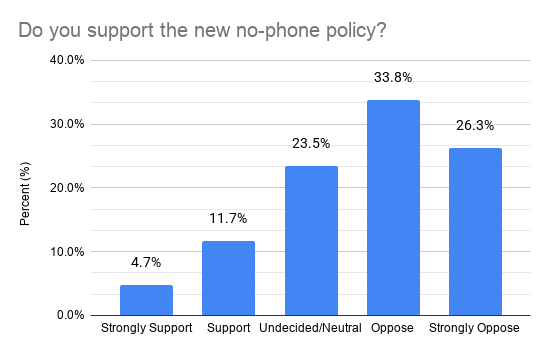
To uncover student viewpoints, The Paw Print conducted a survey of Poly Upper School students, receiving responses from 53% of the student body. When asked how they felt about the new phone policy, only 16.4% of students supported or strongly supported it, while 23.5% were neutral and 60.1% of students opposed or strongly opposed it.
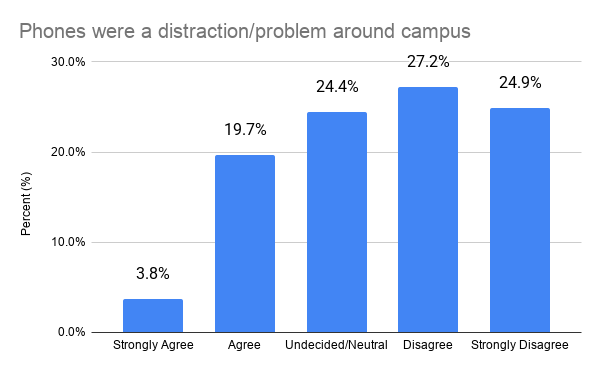
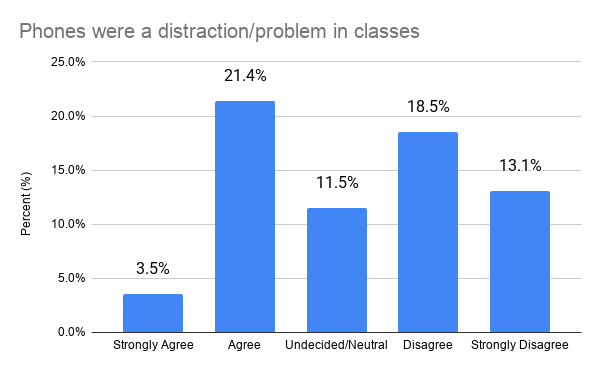
On the other hand, 36.7% of students agreed or strongly agreed that phones posed a distraction or problem in their classes in prior years, despite most teachers requiring students to keep phones out of sight or turned in. Similarly, during last year’s Project Reboot assembly, approximately 61% of students reported feeling addicted to their phones, and nearly three-quarters reported spending more than two hours a day on non-productive screen time.
One of the biggest concerns students expressed was the inability to check the time. Of the 179 students surveyed who had cell phones last year, 49% ranked “checking the time” as the first or second most used function.
“A change in policy is going to take time to adjust to. The beginning weeks were particularly evident that there was a change. People were frustrated and it was a little inconvenient, finding a schedule, finding where you were going and then [finding out] the time,” Goonetilleke noted.
“Coming from the Middle School where we couldn’t have any phones, I thought it was a way for us to have our independence, to have our phones,” junior class president Ayende Terrazas reflected. “So, I thought, ‘Did we need this policy? Was it really necessary?’ But over time, I think I’ve sort of seen its effects. I’ve seen more people become connected, talking to each other more.”
Although the school year only began a few weeks ago, some faculty members have observed that the new policy is benefiting the school community both academically and socially.
“I have not seen any of my students using a cell phone or trying to use a cell phone during class. Before, I would hear the phone ringing if it was in the [cell phone] box. Now, I have not heard anything, so I would say it’s a positive,” reflected Barrientos.
“There’s been more interaction, more game playing, more stuff like that at lunches and at community times. It’s really fun,” shared Williams. “And you saw it last year, people sitting around the table…but they were all on their phones. So, it’s getting back to a ‘let’s build a community thing.’ We were sort of seeing that lack last year. So we’re trying a few things.”
As the year progresses, The Paw Print will continue to report on the phone policy and gather feedback from the Poly community through additional surveys. As the Upper School continues to adjust the new rules, these perspectives may offer greater insight into the policy’s long-term academic and social effects.
“There, of course, were differing views of the cell phone policy. But we needed to take a step back, to a ‘let’s try this,’” Williams said. “It doesn’t mean it’s a policy that’s set in stone forever.”