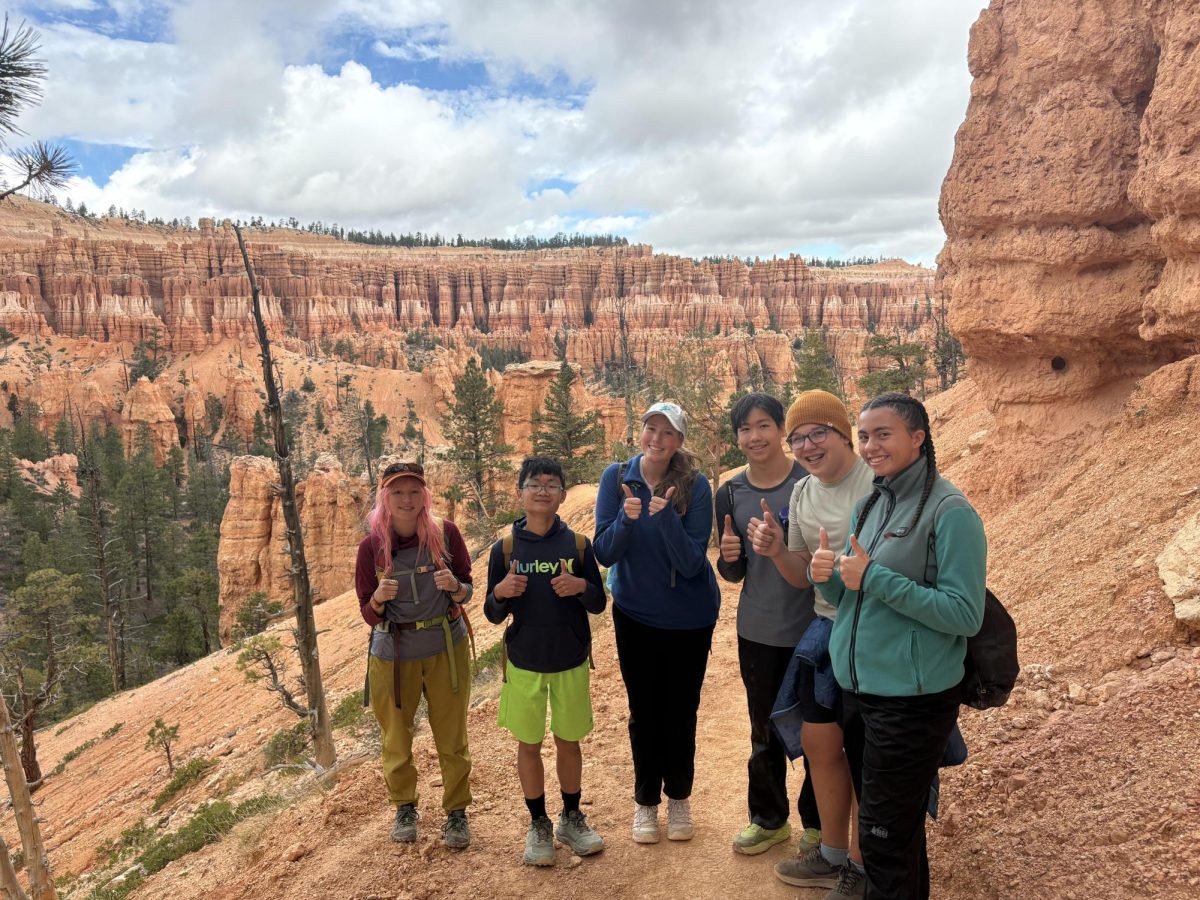













Fullerton 322 is the room where it happens. During passing periods, you can see students clustered on the balcony and filtering into the classroom. If you’re lucky enough, you might even walk by and listen to the faint sounds of students fervently discussing philosophical topics such as transcendentalist writings and nature.
In the previous year, Poly Enriched American Studies (AmStud) only had ten students. Since there was no excess interest, grade requirements for eligibility were the only determinant for who was in the class. However, this year, the popularity has skyrocketed, with over 30 people requesting the class for the 2026-2027 school year. This was largely due to Ms. Marion’s promotion of the class as well as the enthusiasm and buzz shared amongst successful upperclassmen. Junior Lauren Poplock attested to this, explaining, “To be honest I was on the cusp between taking AmStud and APUSH and when senior Anya Matz talked about the quilt project that they did at the end of the year, it really affirmed that this is a great class to be in.” The solution to the influx of interested students: a lottery to determine who gets the 19 spots available in the class. While a lottery seems like a fair selection process on paper because of its objectivity, an opportunity as unique and coveted as AmStud deserved careful consideration and a more meticulous and holistic selection process.
For those unfamiliar with the course, American Studies is an interdisciplinary class that combines AP English Language and Composition and PolyEnriched American History in two class periods. The course is taught by Upper School English Teacher Laura Marion as well as Upper School History Teacher Kristen Osborne-Bartucca. American Studies mainly examines nonfiction texts written by American authors while analyzing them within historical contexts. Unlike the standard AP US History curriculum, the course prioritizes depth of understanding over amount of content covered, allowing students to delve into American history and literature through lenses of social justice, political science, philosophy, art, and culture.
The course demands more than just understanding of the assigned readings. “To be a good student, you need to read a lot, and you need to know a lot. You need to have a porous, permeable approach to the world. You need to read books, watch movies, engage in big ideas, and go to museums. The best AmStud students are zealous about learning about the world around them,” commented Osborne-Bartucca. And she’s right. In an age where someone can just read an AI overview of a textbook, success in the AmStud class, according to Osborne-Bartucca, depends heavily on ravenously consuming media beyond the required course load.
Grades may prove a student’s academic capabilities, but there’s no metric to ensure willingness to contribute to discussion, passion for the humanities, openness to a variety of perspectives, and collaborative personality—facets which contribute to the ideal classroom environment. “The ones most interested in the class are the ones that make the class worth taking because it’s a course that really depends on collaboration and discussion. The students in the class are what make the class,” commented junior Sylvie Shapiro, a student in the class.
Osborne-Bartucca points out, “Some people who have said, ‘I’m a STEM kid, and that’s who I am and what I mostly want to focus on, but I want to take this class’—whether they wanted to take it for their transcript or simply liked Ms. Marion and the idea of the class—end up learning so much more and becoming open to a lot. This type of student may not have struck us as immediately passionate about the humanities if we had interviewed them during the course selection process, but they were that person afterward.” While it’s arguable that students can become increasingly passionate through their experience with the coursework and therefore deserve to explore a potential area of interest, since spots are so limited, priority should go to those whose passion extends beyond following in the footsteps of successful Poly students or simply taking on a rigorous “PolyEnriched” course.
So how does one find the intellectually curious AmStud student? While it can be presumed that everyone at Poly is intellectually curious to some degree, the small class size and passion-driven nature of the class warrant an interview process or interest form. Demonstrated interest already plays a role in deciding who gets into the Poly Enriched Modern Latin America (MoLA) course or the Poly Research Initiative (PRI) program, which operate similarly to American Studies in their approaches to learning.
When applying to the PRI courses, students have to fill out a form that demonstrates a specific interest and purpose for taking the course, which the teacher then takes into careful consideration. Similarly, MoLA has an application system that goes beyond the course request sheet. “The interview process for MoLA went more in depth than that of Amstud. For MoLA, we had to first qualify for the class by having at least an A- overall in the prior class, and then we had to take a written ‘quiz’ and an interview with Profe Levin,” recalled junior Isabel Perez, who is a current MoLA student.
The large influx of people interested in AmStud should require students to undergo a comparable interest-based process. Marion explained, “We haven’t had to conduct interviews for AmStud because this is only the second time the interest has exceeded the space in the class. If the numbers for next year repeat what happened this year, we might need to rethink the process.”
Overall, PolyEnriched American Studies is a unique opportunity with limited availability that students attending other schools wouldn’t typically have access to. The exclusivity factor that distinguishes AmStud from a typical AP course, as well as the collaborative nature of the class, demands a lot of attention to detail when determining who gets into the class. Because discussion is integral to the class, the people are what make the class a lively and intellectually stimulating atmosphere. For this reason, the lottery falls short. With discussion and coursework being so contingent on the interests of the students who contribute, why leave it up to chance?