

















Just last month, a group of five Poly students, including myself, participated in the annual LA County Science & Engineering Fair (LACSEF). The event is both an exhibition and a competition for K-12 students from LA school districts interested in sharing their STEM-related passion projects. The process requires students to conduct detailed research, report their findings and present their ideas to top judges in their respective categories. Based on the judges’ opinions, students are eligible to win numerous sponsored awards and even advance to the California State Fair (CSEF) or the international stage (ISEF). However, in the past few years, only a small number of Poly students from our high school of around 400 teens have participated in this unique and educational event. I believe anyone interested in pursuing STEM should seriously consider an independent passion project, and with it, attend the fair next year.
One of the main reasons more students should participate in the LACSEF is that the challenge of starting a project, which often discourages people, becomes much more manageable when approached the right way. Many students hesitate to join the science fair because beginning a passion project—especially one involving advanced science or engineering—can feel intimidating and confusing. That pressure usually comes from treating the project as something you have to invent just for competition, rather than something that grows out of your own interests. But the reality is, a passion project shouldn’t be specifically for a fair or an application. It’s a passion project, not a requirement or an artificial achievement.
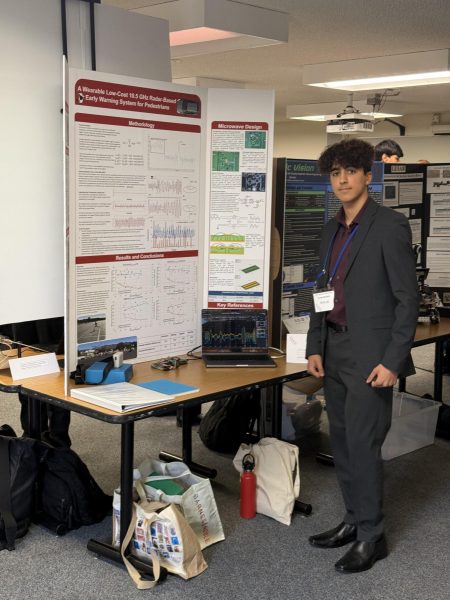
A 2025 and 2026 LACSEF participant, junior Cavon Hajimiri said, “Doing a project because you truly enjoy it is almost exclusively the way to find success at these science fairs. When you first start, forget about the fair. It shouldn’t be forced.”
He went on to explain that his prize-winning project titled “A Wearable Low-Cost Radar-Based Early Warning System for Pedestrians” was something that he created simply out of curiosity. Approaching a project this way makes the experience less intimidating from start to finish, which is exactly why students who are already interested in STEM should participate in LACSEF.
I didn’t even really know what LACSEF was when I started my project. It was the middle of last summer, and I had recently become interested in medicine and biomedical studies. What started as simply Google-searching topics like heart disease soon became a multi-month project, which resulted in a physical, testable device which aims to predict the amount of edema, the medical term for swelling caused by excess fluid trapped in the body’s tissues, under a person’s skin, which can be an indicator of heart and liver disease. It allows elderly patients to accessibly track treatment progress from home. The device projects infrared light onto the skin and receives reflection values through the photodetector IC: the more light is absorbed, the more edema there is. When Site coordinator for LACSEF and Poly Chemistry teacher Robin Barnes told me about LACSEF, the deadlines and requirements definitely encouraged me to stay organized and on time with my work. While the fair shouldn’t be your sole reason to start a project, it can contribute to your motivation and improve your organization.
The process of preparing for this fair is not one that students are expected to complete in a few weeks. Most people spread out the workload over months or work in teams of up to three people, making it much more feasible. Sometimes, a student will also use the same project for the fair each year, developing it further each time, which is what I plan to do. The plethora of online and in-person resources Poly students have access to, including libraries, labs and ebooks, streamlines the research process. Furthermore, there are opportunities for Poly students to connect with professionals from Caltech and JPL through programs like the Summer Research Connection (SRC). The SRC is a 6-week program that places high school participants in Caltech labs to conduct scientific research.
Barnes shared, “While Poly cannot currently create a class or course for the science fair due to the low interest, we do offer funding applications that can help cover materials and costs.”
These cash award applications include the Sabrina Zhang Prize for Interdisciplinary Entrepreneurship and the Dedrick Kon ’96 Fellowship for Exploration of the Life Sciences, which students can apply for and utilize for any project. With these support programs, Poly students are even more prepared for the science fair. We should take advantage of these unique opportunities available to us.
When I asked Hajimiri about the most valuable benefit of participating in the LACSEF, he replied, “For me personally, it was inspiration and motivation I gained from spending time with other students, some of whom are very different from me, and some of whom are very similar to me, but we all share the same passion and interest to create something new.”
Indeed, during the fair, students are surrounded by hundreds of other STEM-oriented teens from across LA County, allowing them to learn about and generate countless new ideas. These peer connections are both impactful in the moment and last as partnerships months beyond the fair.
Another major benefit of participating in this fair is the opportunity to pitch ideas to experts and receive feedback. Students have the privilege of talking to highly qualified judges, who are often doctors, professors, or researchers in the field of the student’s project. Hajimiri explained, “Getting your work validated by experts is unique to science fairs in the sense that when you’re explaining your project to them, they listen to you and basically treat you like an expert, really valuing your work.”
One of the most valuable pieces of advice I received from judges was regarding patenting my device. Multiple judges advised me to consider filing a provisional patent, an option that wouldn’t have occurred to me if not for their feedback.
Perhaps the most important impact of participation is the doors that open when one has a well-researched passion project. Because the fair requires several steps, such as a poster, data and written reports, afterward, students are left with valuable material they can use in other ways. For example, students can use their research as a valuable aid for summer internships, conferences and more. In short, participating in the LACSEF reaps benefits far beyond simply that one event.
Besides the necessary student-led initiative, our school can take several steps to further encourage student participation. When asked what prevented her from participating this year, sophomore Karina Kim, replied, “For me, I feel like it wasn’t widely advertised,” as she didn’t know the fair was an opportunity in the first place. It is essential that the Science Department make a concerted effort to advertise this unique opportunity early and frequently each year, rather than simply make it a brief morning meeting announcement. As a 2026 participant, I can assure you that the work you put into participation is worth every minute and will pay off in the long run.