
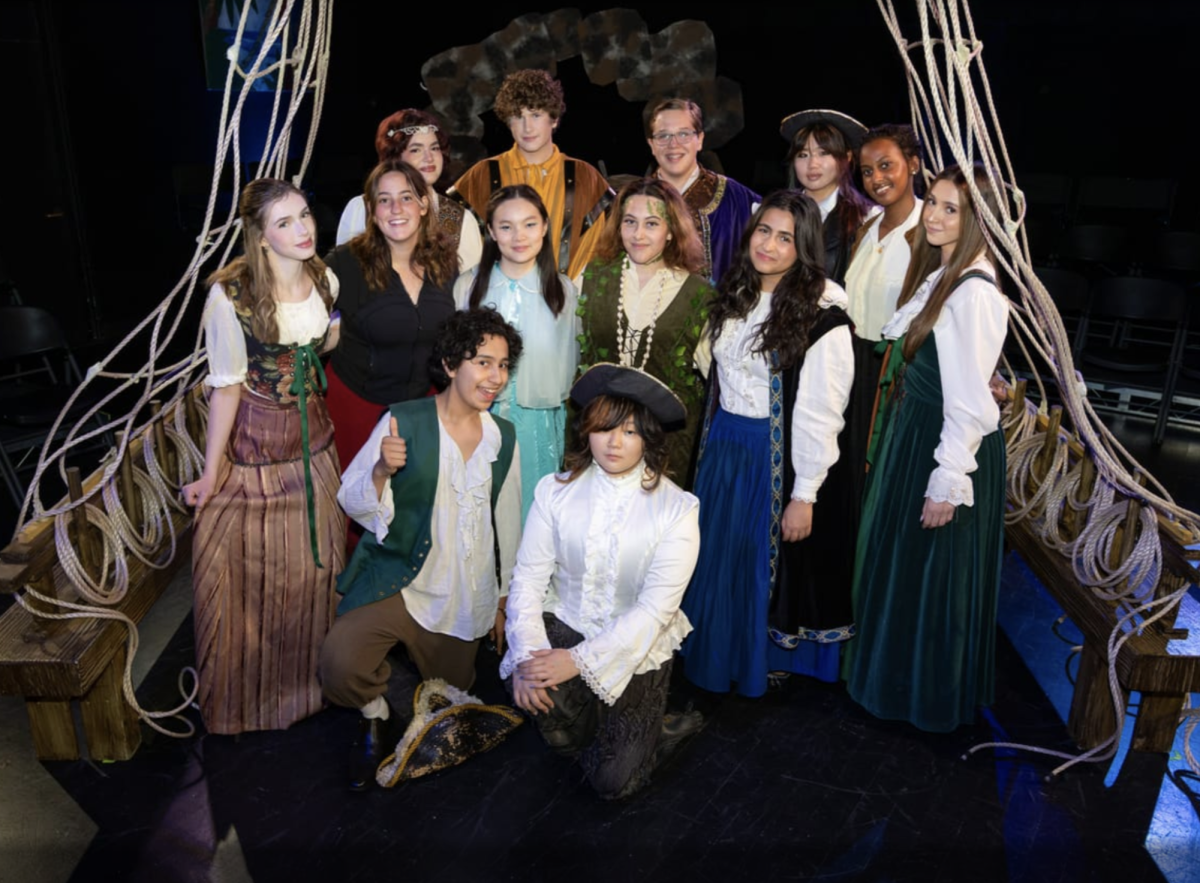





On Thursday, Nov. 5, Upper School Performing Arts students debuted the fall play, William Shakeaspeare’s “The Tempest,” in the Black Box theater. They also ran shows on Friday, Nov. 6 and Saturday, Nov. 7; across the three days, a total of 265 people attended.
In the comedy, Prospero, the rightful Duke of Milan, conjures a storm that shipwrecks the characters on his island in order to reclaim his title and take revenge on his sister. In the Poly production, Prospero was played by junior Amira Shamsi and called Prospera.
Magic was a central element of the production, brought to life through visual and audio effects. The backstage team was led by Upper School Performing Arts Teachers Andrew Villaverde and Richard Sherrell, while Upper School Performing Arts Teacher Sam Robinson directed the actors.
For the first time in four years, the play was performed “in the round,” requiring actors to be dynamic to ensure visibility to the entire audience featured on all sides of the stage.
“Having this play in the round really accentuates the mystical part,” said senior Alexandra Tan, who played the air spirit and servant to Prospera named Ariel. “It brings the audience into the show more than a one-sided show would.”
For Robinson, “The Tempest” offered an opportunity to bring Shakespeare’s blend of fantasy and emotion to the school community.
“‘The Tempest’ is my favorite play that Shakespeare did. I just love the language, the romance, the magic, and I thought that it would really connect with our community,” shared Robinson
However, there were also some difficulties of production when trying to accommodate the cast.
“Adapting the show for our ten actors was a challenge. It has many more characters,” Robinson explained. “[Another challenge was] creating a text that I knew would be manageable for us during our rehearsal time period [Sept. 2nd to Nov. 5th] and accessible to our audience.”
Despite the complexity of Shakespearean language, the actors’ performance helped audience members follow their story.
Junior Sophie Tan, who attended the show, reflected on watching “The Tempest” performed live.
“It’s hard to understand,” she said of the language, “but it makes me rely on more of the characters’ acting and facial expressions to understand what’s going on.”
The goal goes beyond understanding the plot, with Alexandra Tan noting, “I hope that audiences are not only enjoying the play but also seeing the deeper meaning behind it and what argument Shakespeare is trying to make, while, at the same time, appreciating every little thing that’s going into the play.”