




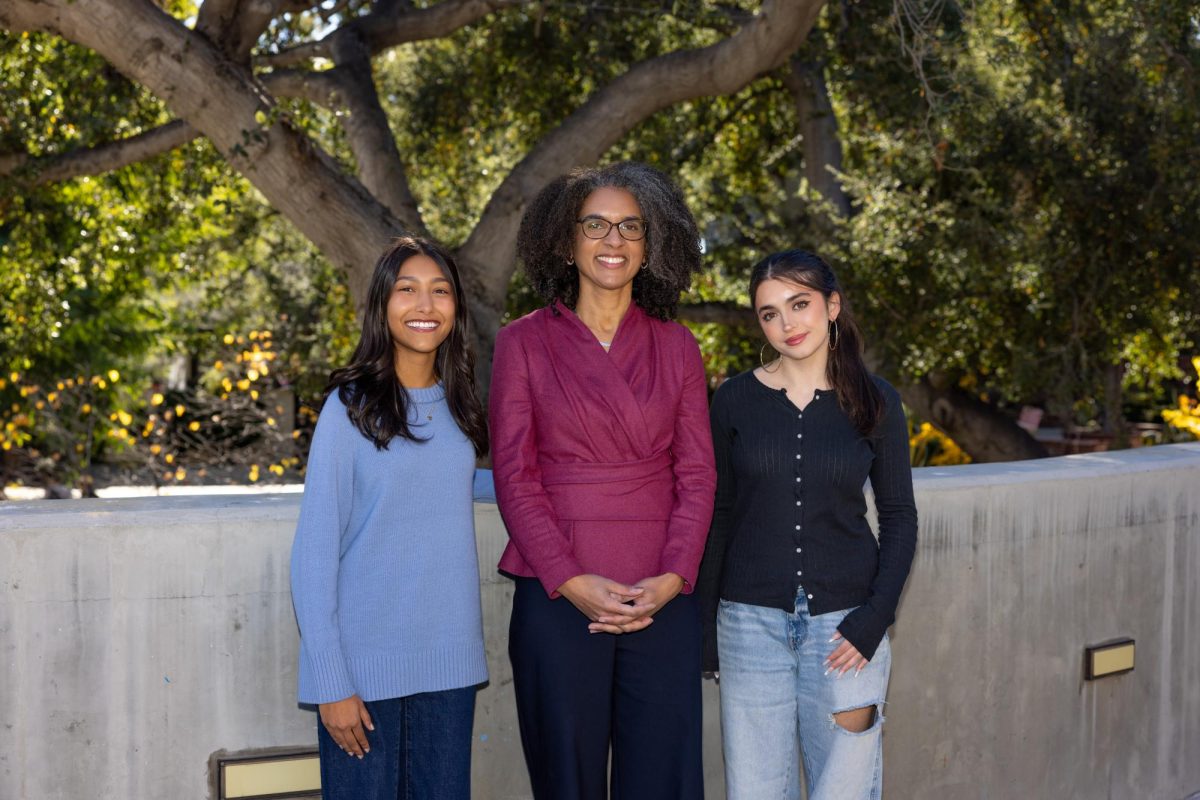


This past summer, Upper School History Teachers Alex Melonas and Kristen Osborne-Bartucca, as well as Founding Director of the Biological Research Initiative Balakrishnan Selvakumar, each led a four-week research course through the Poly Research Initiative (PRI).
Melonas’s seminar, Racial Terror Violence & Los Angeles County, is a multi-year summer research program set to conclude next summer, with 17 students having participated since it started in 2025. Osborne-Bartucca guided eight students through her program titled The Street, the Spectator, and the Self, an exploration of urban life and identity. Selvakumar’s multi-year summer research program addresses the global challenge of antibiotic resistance, with 28 students having participated since 2022. Students in his academic year Senior Biological Research course also study antibiotic resistance.
Selvakumar originally piloted PRI in the summer of 2022 and subsequently established its first three academic year courses in 2023 — Biological Research, Senior Biological Research and Neuroscience & Humanities: Food. These courses helped the PRI receive a $250,000 grant from the E.E. Ford Foundation, an organization that funds selected American independent secondary school programs.
This grant, along with private donations, enabled the extension of PRI into the humanities and arts, first with Visual Arts Teacher Patrick Jackson’s 2024 summer program, From Fantasy to Madness: What the Rococo Art Period Can Teach Us About Imagery in the 2020s. Students in this course researched at The Huntington Library and Museum, comparing European paintings made between 1740 and 1830 with modern art. In the following two years, Melonas and Osborne-Bartucca initiated their own summer seminars.
“The Poly Research Initiative is an initiative that creates time and space for a student to come into a high school classroom and be able to make a real world contribution to a real world space and, through that process, demonstrate real world competencies,” Selvakumar noted.
Melonas’s multi-year course exemplifies this real-world approach. Inspired by the Equal Justice Initiative’s efforts to document lynchings and establish memorials in Alabama for lynch victims, Melonas launched the first iteration of his program in the summer of 2025. It aimed to document suspected cases of lynching in Los Angeles County in the late 19th and early 20th centuries. Building on initial archival work, students in Melonas’s PRI program spent this past summer investigating the broader historical context surrounding those incidents. Next summer, the final cohort will consider how a community can take responsibility for racial terror violence through memorial work.
“You simply cannot tell the story of California emerging as it does, and by extension the United States emerging as it did as the hegemon it’s become in the world, without telling the story of racial terror lynching and the slave trade,” Melonas said.
Senior Brynn Connolly is currently enrolled in both the Neuroscience & Humanities: Food class and the Senior Biological Research course. She has also participated in Melonas’s program the past two summers, after finding his tenth grade Perspectives on Modern World History course engaging. Based on her research, she wrote a statement on public lynching in the United States, which she submitted to “The Concord Review” for publication. She hopes to continue studying racial terror violence in college.
When asked what she gained from the experience, Connolly responded, “Understanding more about my community and how, although it’s a very diverse place, it hasn’t always been that way, and it hasn’t always been a very accepting place.”
She highlighted one case about a man convicted of murder that stood out to her: “He was put on death row, and at his death, they sold 500 tickets to his killing, which was crazy to me because it felt like it broke that barrier between a public lynching and a private lynching.”
Osborne-Bartucca, motivated by her previous research on New York City’s history, focused her program on researching and directly engaging with urban spaces. The class also explored gender roles through the concepts of the male and female gaze. Over the summer, her students observed interactions in downtown Los Angeles and wrote a culminating narrative research essay on a specific topic within urban studies.
“There was a real desire to do this deep scholarship,” Osborne-Bartucca noted of the students. “Having their enthusiasm and their curiosity there every day was honestly one of the best things I’ve done in my 12 years at Poly.”
Junior Oona Doner participated in Osborne-Bartucca’s program and wrote her essay on historical buildings and modern development in New York City.
“It reminded me of why I enjoy writing because we came up with our topics entirely from scratch—no guidance, no prompt,” Doner remarked. “It really ignited my passion for writing and research again.”
After Melonas’s program finishes this upcoming summer, he is unsure of his future work for PRI.
“[Racial terror violence] is hard to read,” Melonas said. “I feel a certain obligation to do another version of the lynching project and find more cases, and then redo the three year cycle and end with community responsibility work. I feel very strongly about that, but also, I don’t want to do that again.”
Osborne-Bartucca is interested in leading another summer course on a different topic and having students visit a local archive, but she also wants to allow other teachers the opportunity to run their own programs.
Selvakumar also referenced this expansion of PRI’s scope, emphasizing the increasing number of applicants to PRI courses. Since 2021, through Selvakumar’s academic year and summer programs, 66 students have published 33 review articles in a journal of the National Human Genome Research Institute; 45 students have generated empirical data or designs for Tufts University, California Institute of Technology or Stanford University; and 151 students have written interdisciplinary research reports, including some work reviewed by New York University.
“A proposal for the future is how we can scale the PRI to accommodate this growing interest in the various spaces of the PRI,” he noted. Melonas reflected, “You can genuinely, in increasingly sophisticated ways, leverage resources at this institution to really go and pursue knowledge in a way that does not center on my classroom, my curriculum, my syllabi, [or] my infrastructure, and I think that should be the culminating experience for Poly students.”