







When I came to Poly, I dreaded presentations and public speaking.
They terrified me. My palms sweated, my stomach rumbled, and every eye seemed fixed on me. Then, speech and debate came along, and my whole perspective changed. Every debate practice, I slowly learned how to use my voice, and, while even now I still get that jittery feeling, I’ve learned to overcome it because of the mentorship of coaches and older debaters.
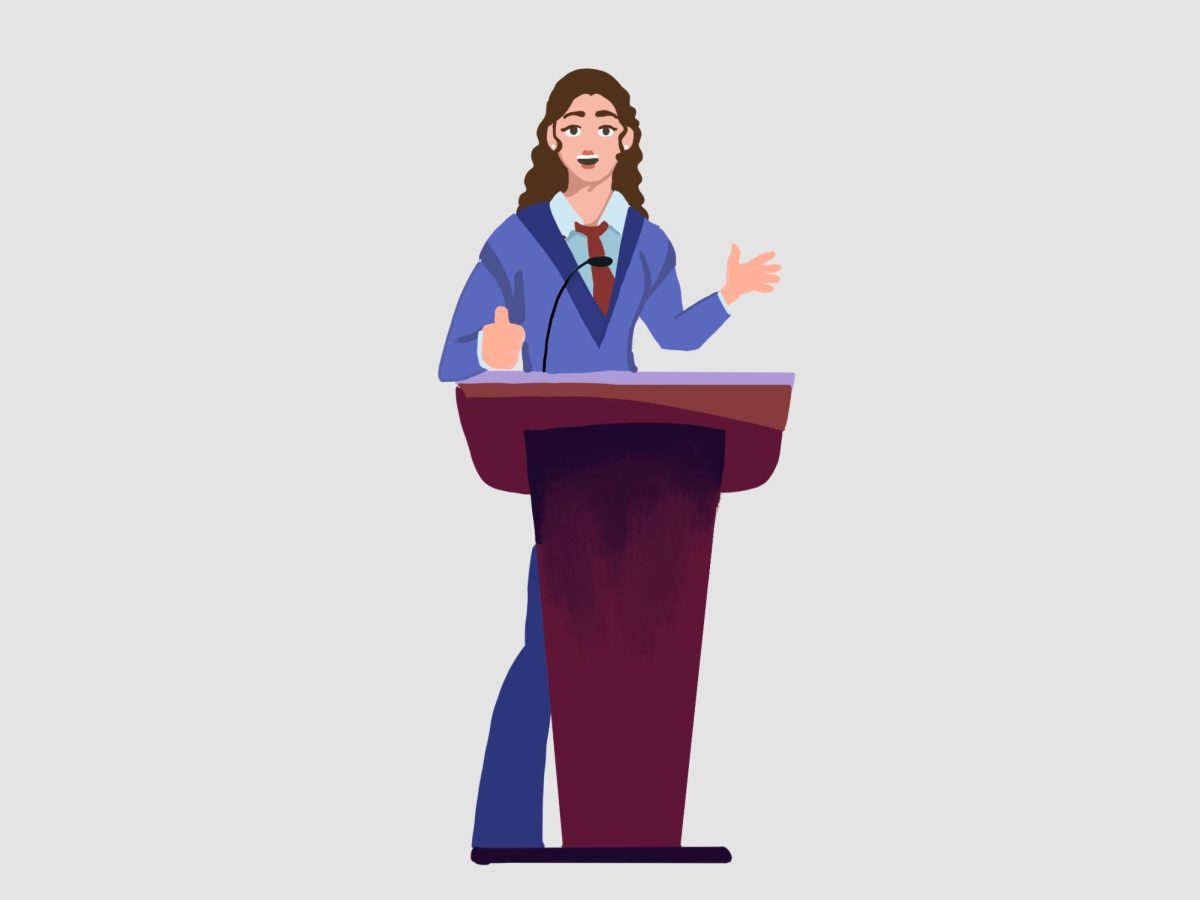
Yet, speech and debate faces a problem: Poly still classifies it as a club. Right now, speech and debate has two coaches dedicated to teaching and moderating the program, a robust leadership group comparable to ASB and class cabinets, over 30 active members, and competitions ranging from local scrimmages to national championships. Speech and debate offers far more than a typical club. For this reason, speech and debate should change from a club into a full elective course.
First of all, why is speech and debate so important? Most importantly, it teaches students to use their voice. Debaters learn how to construct fully fleshed-out arguments with warrants and impacts, spot logical fallacies in opposing arguments, and learn how to conduct in-depth research. These skills directly translate back into the standard Poly curriculum; for example, the research skills taught by debate can be utilized while researching for the annual history research paper. Furthermore, speech and debate introduce students to a tight-knit international community through international tournaments and create lasting friendships that go beyond competition.
Speech and debate would have an even bigger impact if it were offered as an elective class. First, speech and debate practice times would be more accessible. Debate currently meets every Tuesday and Thursday from 6 pm to 8 pm. Upper School Speech & Debate Coordinator Michael Murray states, “When we have an after-school club, the issue is it conflicts with a lot of people’s after-school activities. When it’s a class, it gives them that time period in their day to actually do the work.” In debate, preparation time often determines which team succeeds. A team with more research or practice within a topic can formulate better arguments, form nuanced counter-arguments, and overall understand the overarching questions and consequences of an action. An elective provides time and space for students to hone their skills without interference from extracurricular activities and gives debaters the much-needed preparation time to succeed. This is especially important because the Poly debate program is a relatively small team, which means that there is less research and fewer arguments compared to massive public school debate teams or academies that have hundreds of students.
An elective would provide dedicated debaters valuable time for more practice. For example, if a debater had a tournament on the weekend but had sport practices on Tuesday and Thursday, they would still be able to prepare during the week because of the elective class, without being penalized for missing practices after school. Furthermore, if the debater can come to the after-school practices on Tuesdays and Thursdays, the elective class would provide more time for the debater to prepare. The whole system would rely on the dedication of the debater. If some students only want to come to school practices, they can only come for the elective class. If some debaters want to keep the same after-school schedule because they have no room for the additional elective, they can still keep going to the after-school practices. Finally, if there are extremely dedicated debaters who want to take the elective class and go to after school practices, they can reap the benefits of extra practices and consequent preparation time.
Secondly, an elective provides an opportunity for growth for an already budding program. While speech and debate has continually grown in size and prominence, if it became an elective, it would grow even further because students could find out about speech and debate through the Poly Course of Study. At the very least, this would introduce students to what speech and debate is, which would be the first step in competing in speech and debate
Thirdly, adding speech and debate as a full course would demonstrate its significance and legitimacy. While the general school attitude towards speech and debate is positive, if the administration chose to add speech and debate as a complete school course, it would confirm the significance of the speech and debate program compared to a normal club. As Murray puts it, “There’s a certain respect for the way we look at classes versus a club. You know that there is more onus on what you need to do.”
Poly could implement the elective by placing it within a related academic department. Murray emphasizes that he has messaged the English Department and the Performing Arts Department for the debate elective but has yet to hear back from either since last year. Harvey Johnson, the Upper School Dean of Faculty, states, “I think finding a home for it is probably the first step: talking to the head of department or division.” In addition, Mr. Murray hopes that movements pushing for speech and debate as an elective can start from within the student body, which he hopes would further the cause.
Polytechnic speech and debate has and will continue to teach students important communication skills, and it’s time to recognize its role as a part of Poly’s curriculum. While the program currently functions as a club, it would function better as an elective because of the increased consistency of practices, the accelerated growth of the program from new to dedicated debaters, and the legitimization of speech and debate as a full class. Now all that remains is to continue to push for this change and make sure it doesn’t stop in its tracks.