

















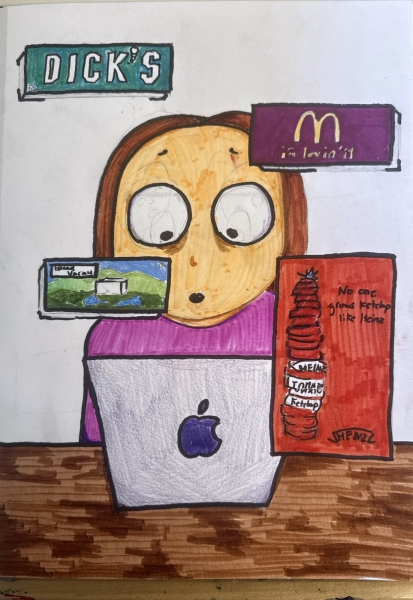
It’s 11:30 p.m. on a Thursday night and you’ve gone through half of the polyatomic ion flashcards for PE Chem, finally getting into a flow. You click through to the next flashcard, when suddenly, the screen blurs. A pop-up blocks your progress: You’ve reached your limit. Upgrade to Quizlet Plus to keep learning.
It’s too bad the only way to continue costs $44.99 annually.
I am no stranger to this obstacle, and most Poly students aren’t either: this sudden disruption is near-universal and no help to our learning. Quizlet has become the backbone of our study habits, but its increasingly aggressive paywalls are forcing us into a corner. We either have to heft over the cash, resort to tedious workarounds or just give up. This is why Poly needs to reevaluate its digital budget and provide a campus-wide Quizlet subscription.
Sophomore Stella Sutton-Stowell has hit the paywall before and tried to find workarounds but eventually finds herself facing a frustrating choice. “I honestly either stop studying or switch to physical flashcards. Quizlet is so much more helpful at reinforcing my knowledge,” she shared.
Beyond the annoyance, being kicked out of a study module diminishes the ability to stay focused in environments where that’s already hard enough. Learning Resource Specialist Becky Weinstein-Sanders described this as the task switching cost. She explained, “When a kid is fully engaged in flow, hitting a popup or paywall makes it much harder to enter deep focus.”
By derailing studying, abrupt paywalls create another barrier to accessibility for neurodivergent students. Weinstein-Sanders noted, “I do think for students with learning disabilities, it may add to the difficulties they already have.”
The inequities that Quizlet payrolls pose, though, are also economic. While a $40-some annual subscription might be an easy out-of-pocket expense for some families, it’s a financial burden for others. It creates another economic divide on campus, where only the students who can afford the tool get the most efficient study experience. In fact, Upper School Media & Educational Technology Specialist Karen Barton mentioned that a student had once reached out to her with a request for Poly to subsidize this kind of study tool, because he wasn’t financially able to support the cost of a subscription.
It’s generally understood that memorization is a significant part of any high school curriculum. The English Department and Mandarin program recognize this, which is why they have asked the Technology Department to pay for Quizlet premium subscriptions for the teachers, allowing them to create class accounts for their students. When a teacher is granted a premium subscription by the Technology Department, they can add students to Quizlet classes, giving students access to premium features just within that class.
However, when students use Quizlet for other classes, they are left to fend for themselves. Upper School Science Teacher Robin Barnes emphasized the heavy lifting required in her Chemistry class. She stated, “At the beginning of the year, it’s very important for students to memorize certain things for this particular class.”
It seems arbitrary that memorizing English and Mandarin vocabulary is subsidized, but memorizing science terms isn’t, especially when teachers recognize its value. Barnes added, “If the school were to provide a resource, I think that would benefit students not just in my class but in other classes.”
To be fair, budgeting for an entire school is no easy feat, and the administration’s caution is justified. The Technology Department cannot just cover premium subscriptions to every app students like. To defend the cost, the school needs a guaranteed return on investment. But with study apps, tracking usage is difficult. “These tools don’t really give us analytics,” Barton explained. She contrasted study apps like Quizlet with a tool like Turnitin, where usage is less questionable, since administrators can actually see the statistics behind how much it’s being used.
In terms of the process for bringing on a new tool, Barton clarified, “The tech request form is really only intended for new tools for teachers for individual or classroom use, not to advocate for students to have their own subscriptions for tools.” This is part of the reason why a schoolwide Quizlet plan does not fit neatly into how the Tech Department currently operates.
Furthermore, Barton brought up a great point that traditional methods, such as writing physical flashcards, can have other benefits. For example, when making flashcards by hand, you actively engage with the material. A 2024 study from the Norwegian University of Science and Technology’s Department of Psychology affirms this: “The precisely controlled hand movements when using a pen contribute extensively to the brain’s connectivity patterns that promote learning.”
However, while making physical flashcards might be educationally sound, the sheer time it takes to handwrite 100 Spanish words and their definitions is a luxury most of us just don’t have. Additionally, arguments demanding guaranteed usage are not pragmatic. The Tech Department could use other methods to see how often students use Quizlet. For example, they might conduct an annual survey, or they could do a pilot year of subscriptions and see how often students use the features. I guarantee they will find that Quizlet is heavily utilized by nearly all students, across multiple subjects, on a daily basis.
Poly does an incredible job of giving us high-level research tools. But as our academic lives become more digitized, the tools we use for daily learning shouldn’t be treated as a luxury for those who can’t afford it. Our definition of “essential resources” needs to evolve. Reevaluating our current subscriptions – perhaps trading the platforms we rarely touch for a school-wide Quizlet subscription – would eliminate a daily headache, level the playing field and invest directly in how we truly learn.