






There are four students in my Poetry class. Perhaps four sounds like a class still waiting for more to arrive, yet to me it’s the reason why Poetry has become the highlight of my schedule.
With only three classmates, I have more opportunities to explain an idea and hear a response. Thoughts can be left unfinished, but someone else can easily pick up its loose thread. I can reconsider, elaborate, try again; the beauty is how far my voice carries in such a small space.
This is what I want all Poly students to experience. The school already supports small electives when staffing allows. The Upper School Course of Study should include student and teacher accounts of what their size enables, alongside enrollment and workload in past years.
When I asked our poetry teacher, Middle and Upper School English and French Teacher Kyanh Tonnu, what made our unlikely class possible, she described a curriculum responsive to the people in it. “I literally feel like I am shaping the curriculum with the students,” she said.
Our personalities enter the planning, our interests influence how a lesson arrives and even our silliness has a place. If someone is absent, a workshop can wait, and the course bends around the people taking it. Everything is collaborative; Tonnu and my classmates shape how we learn.
I felt something similar in Upper School Film Teacher Adam Feldmeth’s Film as Philosophy class. The first day brought more than twice as many students as the second (14 to 6), yet the final class of five was what I loved. Feldmeth offered a generous explanation of the other students’ departures: needing a free period, discovering different expectations or feeling unsettled by the visibility a small group brings. “The opportunity to be seen fully as a student is unavoidable and perhaps uncomfortable,” explained Feldmeth.
Visibility asks something of us. In a small group, each person has more responsibility for keeping conversation moving. Four people cannot make much of a crowd to disappear into, and what I experience as an invitation could very well feel like a harsh spotlight to another.
I thought fewer students meant distilling only the most interested, but the small class size alone cannot guarantee a meaningful class. Those of us enrolled in small classes are responsible for what we do with that attention, and what smallness offers is an opportunity for closer attention, more participation, and more agency.
Sophomore Brendan Chung found a more practical benefit to the small class size of Wood Design. He enrolled partly because he needed art credit, then spent the semester finishing a wooden chair. “The smaller class size makes it much easier to access tools whenever I need them,” she said. For Chung, fewer classmates meant less waiting and more time to work, yet he would understand if Poly canceled an elective because of low enrollment. “I understand logistically it’s very difficult to coordinate so many classes and not everyone can get exactly what they want.”
All I had been thinking was that the size of an elective directly correlated to who truly had unabashed love for the subject. However, I now see that credit and curiosity are not mutually exclusive. Schedules need to be filled, requirements met, interests tested and those reasons can overlap—can change, and someone can contribute rewardingly to a class without giving their whole heart to a subject.
It’s easy to forget that there is more that goes into running a class than just the benefit of four students. Teachers have finite schedules and extensive workloads.
Dean of Faculty Harvey Johnson explained that enrollment around five or fewer prompts discussion over immediate cancellation. “If the teacher has the capacity and we have a room, we run it,” he states.
Small classes still require preparation and a teacher to lead. Tonnu noted, “The prep is the prep. It doesn’t matter how many kids there are.”
It is true that Poly cannot be obligated to provide every elective every term, no matter the enrollment. My attachment to Poetry cannot settle questions of fair workloads or decide which other course should give up a place.
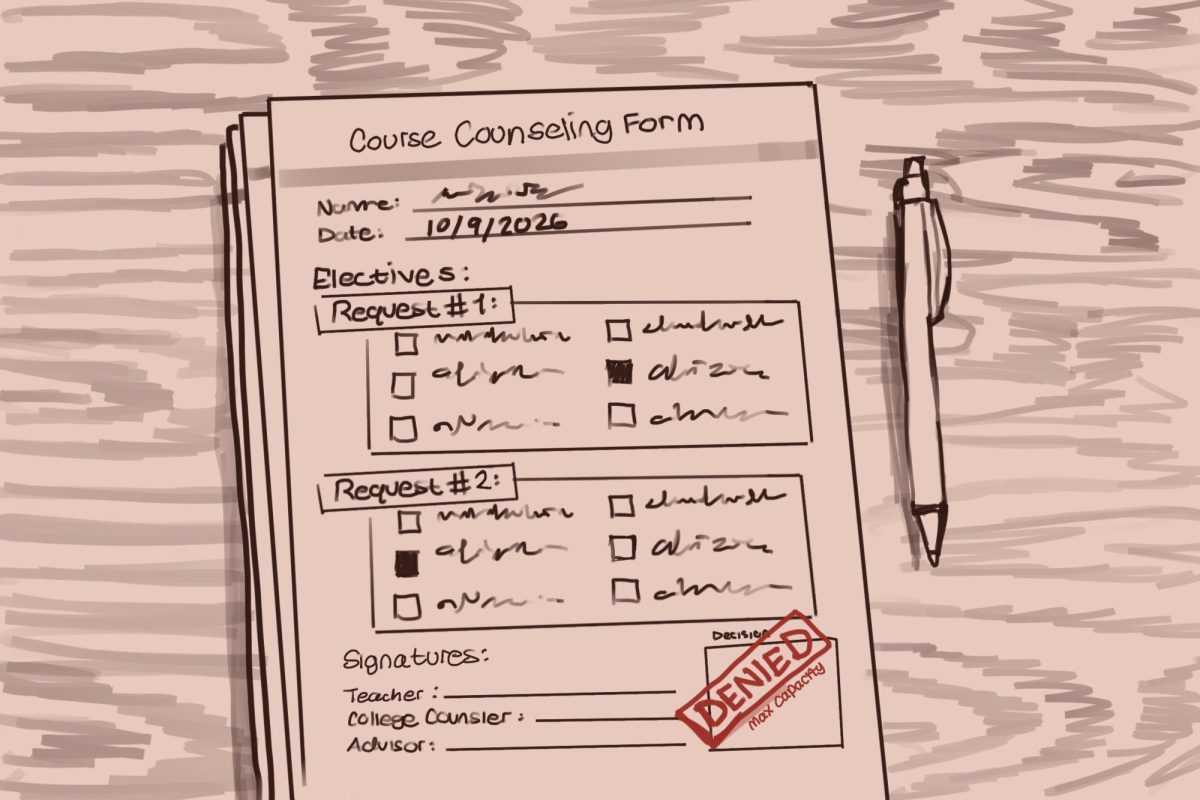
But students should have a chance to understand these opportunities before deciding whether to enroll. When I mentioned my Poetry and Film as Philosophy classes to students, some didn’t even know they were courses Poly offered. Therefore, students and advisors should be careful in going through all class offerings during course counseling.
When staffing cannot support running a small class, Poly could consider offering it in a later semester or alternate year, and communicate that possibility during course selections.
I want Poly to preserve a path into these classrooms. Students should have the chance to enter them with curiosity, hesitation or an arts credit still to finish, with the hope they will come away more fulfilled.
Near the end of our interview, Feldmeth returned to a word I had used: niche. He spoke about electives often taking the backseat beside required courses. And yet, he described their importance beautifully. “The margins are part of the page,” he shared, noting that while the margins support that space, they are also “the open terrain in which the reader becomes a writer.”
In Poetry, our questions, interests and responses influence what happens next. All students should have a change to do this during their high school experience. While Poly has limited room, I hope it keeps making some for us. Four names may fill only a margin, but we must still explore what we can keep writing there.