






















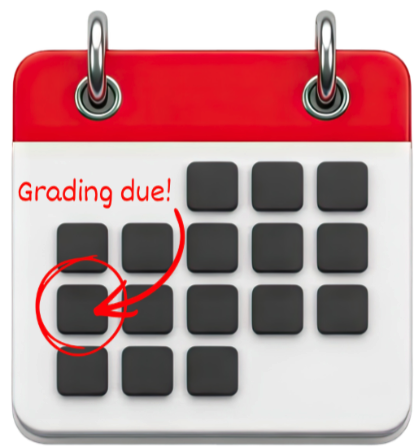
While students at Poly are expected to meet strict deadlines for their work, teachers are often not held to the same standards. Teachers demand that students abide by clear due dates. When students turn in work late, they face penalties. The History Department has an explicit late work policy: For major assessments, late submissions will be penalized by 1/3 of a letter grade per school day, up to a maximum penalty of 20%. Similarly, the English Department’s policy states that for major assessments, late work will be penalized 10% for up to one week past the assigned due date and 15% for work submitted between one and two weeks late. Teachers should be required to return the work five school days before the next assessment in that same area. In other words, an English teacher should return an analytical essay five days before students have another analytical essay, and a math teacher should return a quiz five days before the next quiz.
It’s nearly impossible to improve without feedback.
When students are assessed again before getting feedback, they are denied a meaningful chance to improve. Feedback is what turns assessment into learning. Without feedback, students simply repeat the same process without understanding what needs to change. This can manifest in repeating harmful study patterns, studying incorrect material, or making similar mistakes in solving problems or writing responses. If growth is the goal at Poly, timely feedback is necessary. For example, if a history test on the Vietnam War is returned only one day before a test on the Gulf War, a student does not have enough time to meet with the teacher, review mistakes, or meaningfully improve.
The five-day length ensures that students have enough time to set up a meeting with their teacher and always have a weekend to study before their next assessment. That time is crucial because weekends are the most effective for studying for upcoming tests since weekdays are filled with classes and extracurriculars.
The policy would apply within each category, so teachers would not necessarily have to return assessments in one category five days before an assessment in a different category. For example, a test on Spanish grammar does not necessarily have to be returned five days before a quiz on Spanish vocabulary. I recognize, of course, that this standard may be difficult to uphold.
English Department Chair Serra Leroy noted, “It is extremely hard for teachers who teach four core courses, which is what we’re expected to do as a history or English teacher, to then give really thoughtful feedback.” Last year, Poly introduced a new policy requiring all work due one week before mid-quarter and quarter deadlines to be graded by those deadlines. However, this expectation can be demanding. Some departments, including English and History, assign longer assignments like major papers, often requiring closer to two weeks, and in some cases more, to grade thoughtfully. When asked about the importance of having time to grade, Leroy said, “For me personally, the amount of time I have to grade impacts me a lot.” Leroy recalled that when she attended high school, her AP English Literature class was very large, so the feedback she received on her writing was lacking because of the teacher’s limited time to grade so many papers. She explained that Poly’s smaller class sizes allow teachers to provide more thorough feedback in order to improve students’ writing skills. However, limiting grading time could lead teachers to reduce the quality and quantity of their feedback.
Under my proposal, teachers would not issue new assessments before returning previous ones, providing students with ample time to review their feedback and resulting in fewer assessments overall in the calendar year. If Poly were to adopt a five-day feedback policy, however, it must also create ways to make that policy applicable. In addition to reducing the number of assignments, another approach could involve targeted feedback models, where teachers focus each assessment on one or two key skills rather than attempting to comment extensively on every aspect of student work. This method preserves the depth and quality of feedback while making grading more manageable.
Finally, the administration could create designated grading windows in the academic calendar or prohibit new major assessments until previous ones are returned. For instance, Poly could embed more class-free days into the schedule for teachers to catch up on grading or convert one extra help time a week into a designated grading period. Similar to Leroy, Upper School Dean of Faculty Harvey Johnson believes that teacher feedback is necessary for improvement. He says, “It’s almost uncontroversial to say that it helps to get feedback. That’s the whole business of school, right?” He agrees that timing is important, but admits, “I have not varied it enough to know.” As a math teacher, Johnson typically provides feedback by correcting errors in calculation and reasoning, which does not require the same depth or time as grading written work. Ultimately, this issue is not about placing any blame on teachers, but about creating a fair, growth-oriented academic culture.
As Poly students, we are held to clear and measurable standards when it comes to deadlines because accountability matters wherever you go in life. That same principle should apply to grading deadlines because it directly affects our ability to improve not only as students, but also as humans who need time to learn. Both Leroy and Johnson agreed that feedback is essential to learning, but without a clear and consistent system to guarantee it is returned promptly, students cannot use it effectively to improve. Requiring grades to be returned at least five business days before the next assessment would promote greater fairness on Poly’s campus.