
















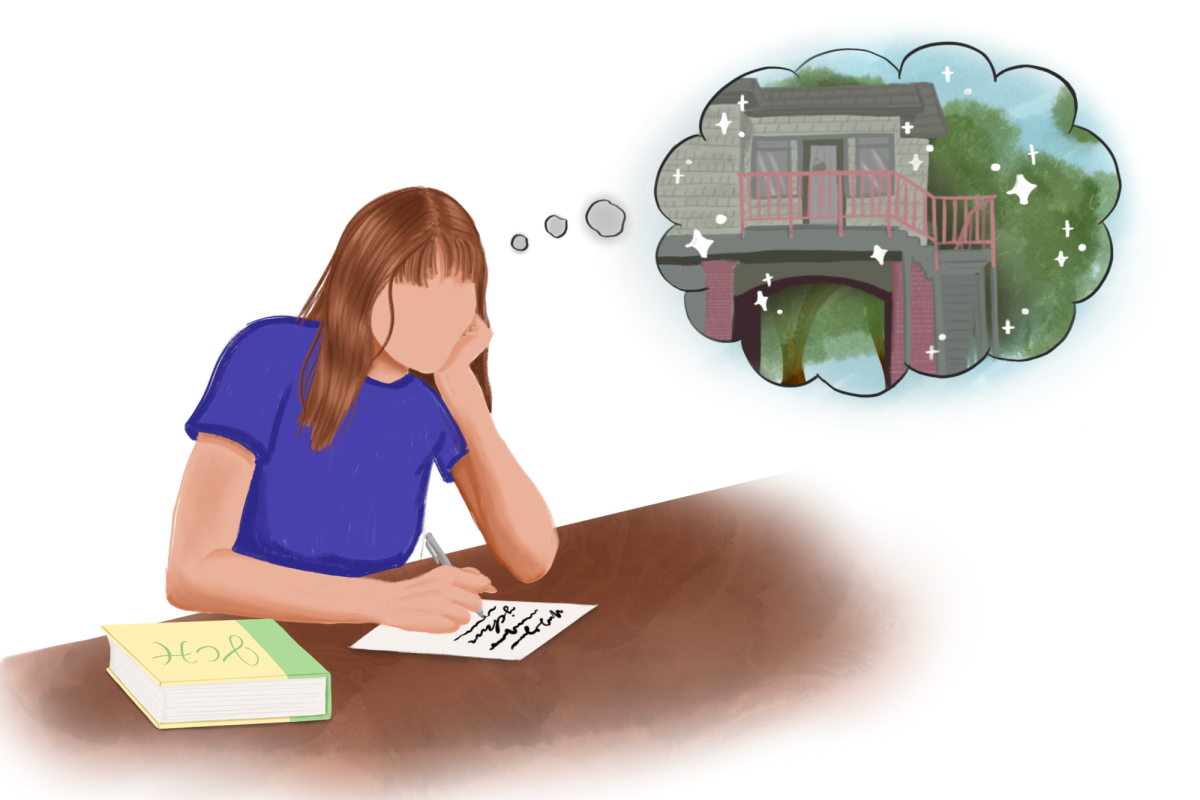


The bell rings in your ears. You pack up your pencil bag, laptop and water bottle into your backpack while stuffing loose papers back into your binder. You rush to grab your phone, strap on your absurdly heavy bag and sprint to your next class just to be marked tardy for being two minutes late. The pit in your stomach gnaws at your spirit as you sullenly unpack for your next class.
This mad sprint and inexplicable dread are the realities for students across the Upper School. Currently, the tardy system at Poly remains rigid and inflexible, and it’s time for a change.
But, the first question one must ask when rethinking the tardy system is why even have a system in the first place? Tardy systems train high school students to practice punctuality, the practice of arriving on time. In the real world, being punctual sets the impression that you are actively engaging with the person you are working with and respect their time. Upper School Dean of Students Jennifer Cardillo commented, “Punctuality can be very important to the impression we make in school, at work and in life outside of school and work.” Essentially, high school is the training ground for the future.
The problem arises when this system is built on vague guidelines and dodgy language. When you enforce a problem, there needs to be a rhyme or reason on how and why the punishment is enforced. In the current system, the “why” is thoroughly explained but not the “how.” When a system is fundamentally unclear, it leaves students questioning its legitimacy and even just the reasoning behind it. Poly’s tardy system has been long due for change.
First, what major problems afflict the tardy system? One of the major gripes I have with the current tardy policy is inconsistency. The general rule of thumb is that a student is marked tardy five minutes after the class begins, but the policy is applied inconsistently by teachers. In the official Poly handbook, Poly mandates, “Students are expected to arrive on time to classes. Tardiness is disrespectful to teachers and classmates. Without a note, tardiness is automatically considered unexcused. A student who is tardy five times will be assigned detention.” The handbook contains no mention of specific guidelines or times on when to mark students tardy or not tardy. How can you expect a student not to be tardy if you never directly tell them the exact expectation? Is it five or two minutes late? The tardy system is left completely up to chance.
One day, a student can be five minutes late without a single hitch; on other days, a one-minute delay sends them spiraling into self-loathing and ruins what would otherwise be a normal day. When tardies are left to the teacher’s discretion, they are not assigned by hard guidelines but by the teacher’s whims. Senior Ethan Hoffman commented, “One day, I was two minutes late to Computer Science, and I got a tardy. Meanwhile, I can be several minutes late to math, and nothing happens.”
Hoffman’s comment reveals a glaring weakness in the current tardy system. Every single teacher at Poly is unique. Some teachers may be stricter than others when it comes to the tardy policy. Cardillo shared, “Teachers have some discretion about when and how strictly they will mark students tardy after that hard start time or after the soft start passing time.”
Because of that discretion given by Poly to teachers, tardies are often decided by the teacher’s own view of the problem. One teacher may allow students to come to class within the first few minutes of the bell ringing. Others give tardies as soon as they themselves are in the room. The second student is not necessarily more tardy than the first student. In fact, the first student may end up with more tardies than the second student if the tardy system were fair to all students. The stark reality is that the current system unfairly punishes students while letting others get away scot-free based on a choice out of students’ control.
When tardies are assigned seemingly at random, it adds unnecessary stress for high school students. High school life is already stressful: extracurricular activities, sports, art and homework pile on student workloads. The average high school student has so much on their plate; why add another stressor? My major complaint is not that schools should not have tardy policies, but that the current tardy system is inconsistent and makes students gamble on whether they will be considered tardy.
Another concern with the tardy policy is the lack of understanding of why students are tardy. I firmly believe that most students do not intentionally go out of their way to be tardy, but the reality is that in between classes and in classes, a lot can happen. On some occasions, teachers let students out five minutes before the bell rings, giving students ample time to attend to whatever they need. However, most commonly, teachers keep students in class right up until the bell rings––and sometimes a few minutes after the class’s official end time. Freshman Darren Chung said, “I think being let out late is definitely a main reason I have been late to class.” While getting a full hour of class time is perfectly reasonable, the issue arises as students scramble to pack up and dash to their next class, which may be across campus.
I’ll walk through the average journey of a student; first, they pack up from the class, taking around one to two minutes, then they walk across campus, taking two minutes. Along the way, they greet their friends, strike up a conversation with a teacher and go to the bathroom. Eventually, all of these factors compound into the student exceeding the passing grace period. Now, even if the example above seems like a extreme case, at least once every six-day cycle, students take route exactly mirroring this one.
The abolition of passing periods highlights another problem with the tardy system, which is the simple fact that most teachers are not set up before the first five minutes of class. Teachers first take attendance, then set up the lesson for the day. In the time it takes to be tardy, students do not actually miss any substantial content taught within the class. When you come to calculus, the teacher won’t be teaching derivatives from the first minute of class. The history teacher won’t be in the middle of a lecture on Islam. The point of a tardy policy is to encourage students to come to class on time. But why is it important for students to come on time? One of the major reasons is that students are not missing crucial information taught in the class. But, if a student is one minute late and marked tardy, did they truly miss anything crucial that required them to be there? For the majority of cases, the answer is no.
Right now, Poly needs to find the middle ground between a rigid, strict tardy system and a relaxed, carefree one. The issue of the tardy system contains complex mechanisms, shifting, fluid circumstances and differing perceptions of what it should look like. Upper School Attendance Coordinator Catherine Stebbins shared, “So there are all sorts of things that could be true but conflicting and need to be untangled to figure out how to fix the tardy policy.”
The problem with solving the tardy system is that it can be either too extreme or too relaxed. The revised system should incentivize students to come to class on time while leaving wiggle room for students to do what they need to do.
Interestingly, the passing period system, the most common system used by other schools, was even more ineffective than the current Poly system. Stebbins commented, “When we switched from passing period to no passing period, tardies went way down.” She goes on to say, “My personal theory is that when the passing period was designated, it felt like time that belonged to the students out of class. It was used as a time to communicate with each other, hang out a little bit, and then get to class”.
So, the solution to the tardy system is not a single simple fix. The solution must go beyond the scope of one policy action. Even so, Poly should still act to mitigate the problems by taking three steps.
First things first, the Poly Handbook is in need of an update. The current statement leaves too much room for interpretation. All it states is that students who arrive at class “late” will be marked tardy, and after five tardies, the student will receive detention. The handbook never clearly defines what counts as “late.” Is it two minutes or five? It leaves ambiguity in an otherwise easily fixed definition.
An explicit statement of five minutes after the start of class would eliminate the inconsistency but retain the benefit of no passing periods. Now, students are still pressed to go to class as soon as possible, limiting the time in between classes, while keeping tardies consistent throughout the classes. It would act sort of as a shadow passing period. Students are under the impression of the current system; meanwhile, the underlying tardy policy would standardize tardiness across all departments and classes. It is a subtle yet clever way to get the best from both worlds.
To maintain the legitimacy of the proposed solution, a student-led commitment to coming to class on time regardless of the shadow passing period must be upheld. The Poly Honor statement sums up how students should act: “As a member of the Polytechnic community, I will act to foster inclusion and to promote excellence in all I do. I commit to approach my actions with integrity, kindness, and generosity both on and off campus.” Only with students who exhibit Poly Honor can this tardy system exist.
Secondly, teacher commitment would need to go hand in hand with this updated Poly handbook. Faculty in every department would need to apply this new discipline to their tardy decision-making. Simply writing the change in the Poly handbook wouldn’t change reality: only a complete mindset change would. Additionally, teachers should start and be in class on time. Though there are sometimes extenuating circumstances, when teachers arrive late to class not only is less content taught but students are also incentivized to be late, knowing their teacher always arrives late, and it sets the entire class––teacher included––behind.
Third and most importantly, accurate data on tardies should be recorded. Stebbins notes that she had tracked data before out of sheer curiosity, but the administration never acted upon it: “We’re sort of talking about something that could be analyzed through data that we’ve kept. That’s a way to sort of approach it and see what that reveals. I tend to do that towards the end of the school year, just out of curiosity, but we’re not necessarily using it as a basis for making adjustments. So perhaps the case could be made that is one way to do it.”
Reliable data is a prerequisite to effective policy and implementation. With improved and prolonged data, Poly can address discrepancies between years, periods and classes and respond accordingly.
In combination with the five-minute shadow passing period, Poly could fine-tune it based on data collected from previous years. The proposed solution would not be a stagnant rule but rather be fluid and adaptable. The solution above is only the first stepping stone towards a fairer and stress-free environment.
One thing is for certain. Without change, the current Poly system for tardies forces students into a cycle of unnecessary stress for things out of their own control. In this imperfect system, students run like mice, scurrying from class to class, gambling on a lunch detention every single day. Poly needs to change the tardy policy, and it needs to change it now.