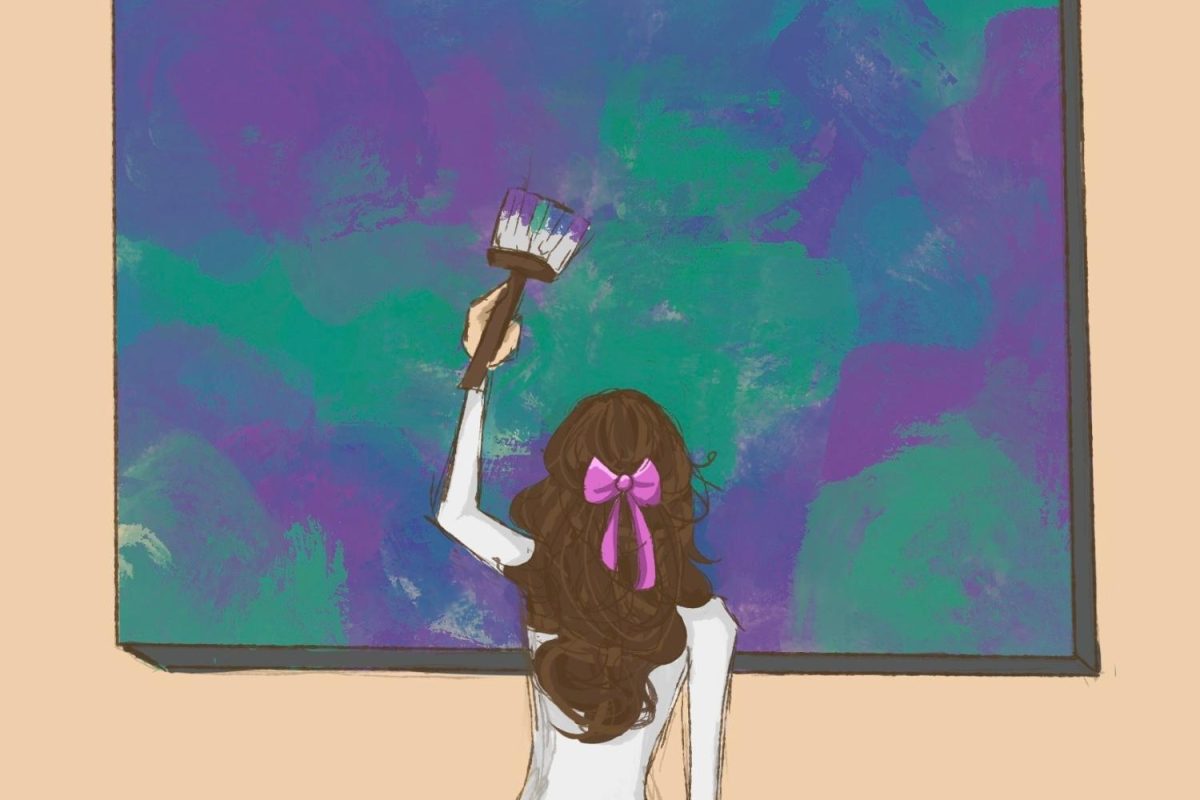






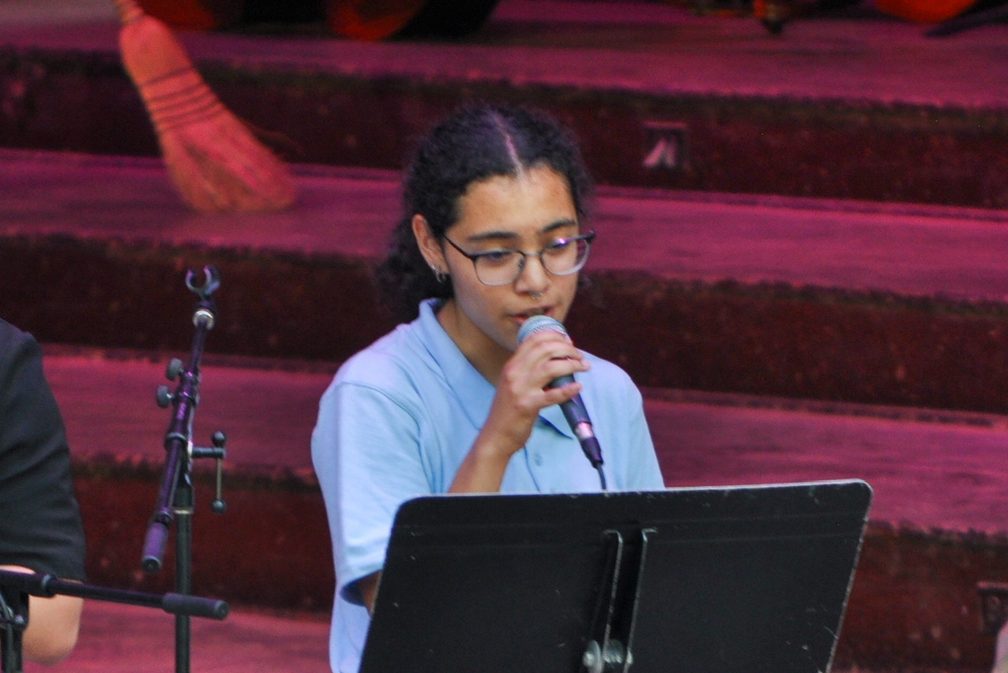
For senior Sofia Flores-Castro, music has always been about both inheritance and evolution; it’s something she was born into, resisted, then mastered and redefined for herself. Raised in a family rooted in traditional Mexican music, she grew up surrounded by rehearsals, performances and a community where music was less a hobby and more a way of life. “I guess I have to start with my parents,” she said. Her father, originally from Veracruz, Mexico, performs traditional music, and much of her childhood was spent immersed in that world. Her uncle plays in Quetzal, a band widely respected in the Chicano community. In Flores-Castro’s family, music is collaborative and intergenerational. Her grandfather runs the Eastside Cafe, a small venue where traditional music lessons are held, and her father sometimes teaches. Flores-Castro described it as a grounding space that balances with the rigor of her academic life.Despite being surrounded by music from the start, Flores-Castro did not initially embrace formal training. In kindergarten, her mother enrolled her in piano lessons, deciding it was time for her to follow in her family’s footsteps. “No, no, I hated it,” she said without hesitation when asked about those early practices. Despite her family’s ever-present high expectations, she began appreciating music as she improved. Skill inspired confidence, then enjoyment.
For Flores-Castro, eighth grade was a turning point. When experiencing online choir due to the COVID-19 pandemic, she explained why it felt so uncomfortable, “It’s such a community thing, and doing it online really makes it so awkward.” While choir practices over Zoom felt somewhat embarrassing, the slow pace of quarantine gave Flores-Castro space to practice both her vocals and piano skills. Her mindset about music started to change. As her fluency developed, so did her ability to connect with other musicians, even through online platforms. She appreciated how these platforms allowed her to immediately follow someone’s playing and respond in real time, creating a sense of community.
Then Poly Upper School’s diverse array of classes and electives led Flores-Castro to something unexpected: jazz. “I was such a purist when I was younger,” she explained. “I was like, ‘I hate jazz. Classical is the only real music.’ I was a little freak. And then I just grew up.” She became intrigued by jazz in her freshman year, when she took Middle and Upper School Performing Arts Teacher Eric Lifland’s Music & Culture: History and Application class, in which she learned about traditional music from countries all around the world.
Jazz introduced her to a radically different philosophy of music-making. Central to the genre are standards, songs widely known among musicians that provide a shared framework. She described, “You know, the bones of a song.” After providing the basic melody and chord changes, the standard invites musicians to layer on your their interpretation and improvisation. Unlike classical music’s strict rules that demand adherence to the written score, jazz focuses on perspective. She expanded, “You can be with random people and say, ‘Hey, let’s play this song,’ and everyone knows it, but they’ll play it with their own little flavor. And I think that’s really fun.”
Coming from a classical background meant knowing how to stick to the books. Improv did not come easily to Flores-Castro. She confessed, “I was terrified of it for a long time.” Letting go of that rigidity required vulnerability, and she had to relearn some things that she thought were firm facts about music.
Flores-Castro focuses primarily on voice and piano, though she dabbles in bass. Quickly downplaying her skills with her characteristic humility, she laughed, “Saying ‘I play bass’ is hard. I kind of just do whatever.” She now comfortably identifies as a vocalist, an identity she might once have resisted.
Lifland, who has known Flores-Castro since the fifth grade, witnessed this transformation firsthand. “She definitely transformed from being a kid who would be scared to sing on stage by herself…Now, she just goes up there in front of the whole school on Grandparents’ Day [and] confidently gives a solo everyone’s talking about,” he explained.
Outside of Poly, Flores-Castro continues to work on bass and participates in the Los Angeles Children’s Choir. In school, she takes part in Vocal Ensemble, which she described as having a playful, musical theater energy that maintains a light-hearted atmosphere. Flores-Castro explained, “It’s just fun. I feel like I’ve pushed myself to be so rigorous with my music that when I go to vocal ensemble…it’s so different and it’s so funny.”
She prefers performing in the pit orchestra for productions rather than acting onstage, having done pit for multiple years. Though not officially in a jazz band, she regularly plays with friends in informal weekend sessions, forming an unofficial band. She is a member of the Poly Arts Student Council and performs at cabaret nights, where she’s greeted by a dedicated fanbase.
“People, when they see her name on a vocal night program, get really excited to hear what she’s got and look forward to her song,” said Lifland.
When asked what music offers that other art forms do not, she initially joked, “Music is life.” Then, more thoughtfully, she reflected that it is one of the fastest ways to understand someone. “Everyone listens to something. If you don’t, you’re kind of a freak,” she laughed. “It’s a really good way to get to know someone quickly.”
As for inspiration, Flores-Castro first said Lifland before naming Wayne Shorter, whose innovations mirror her evolving musical ideas. In addition to studying biology, Flores-Castro plans to major in music, sound, and culture, a degree offered at Tufts University in Medford, Massachusetts. For younger students balancing Poly’s workload with artistic passion, she shared a nugget of wisdom: “Know why you’re doing it. If you want to perform, perform. If you want to do it for yourself, do it for yourself. Just know why.” For Flores-Castro, that “why” has grown from obligation to mastery to genuine love for her craft. Wherever she goes next, music will continue to be the language she brings with her.