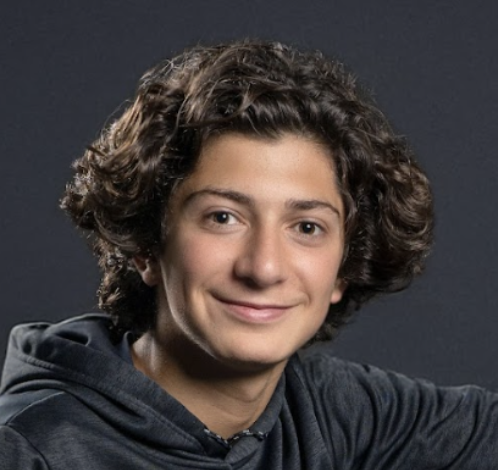






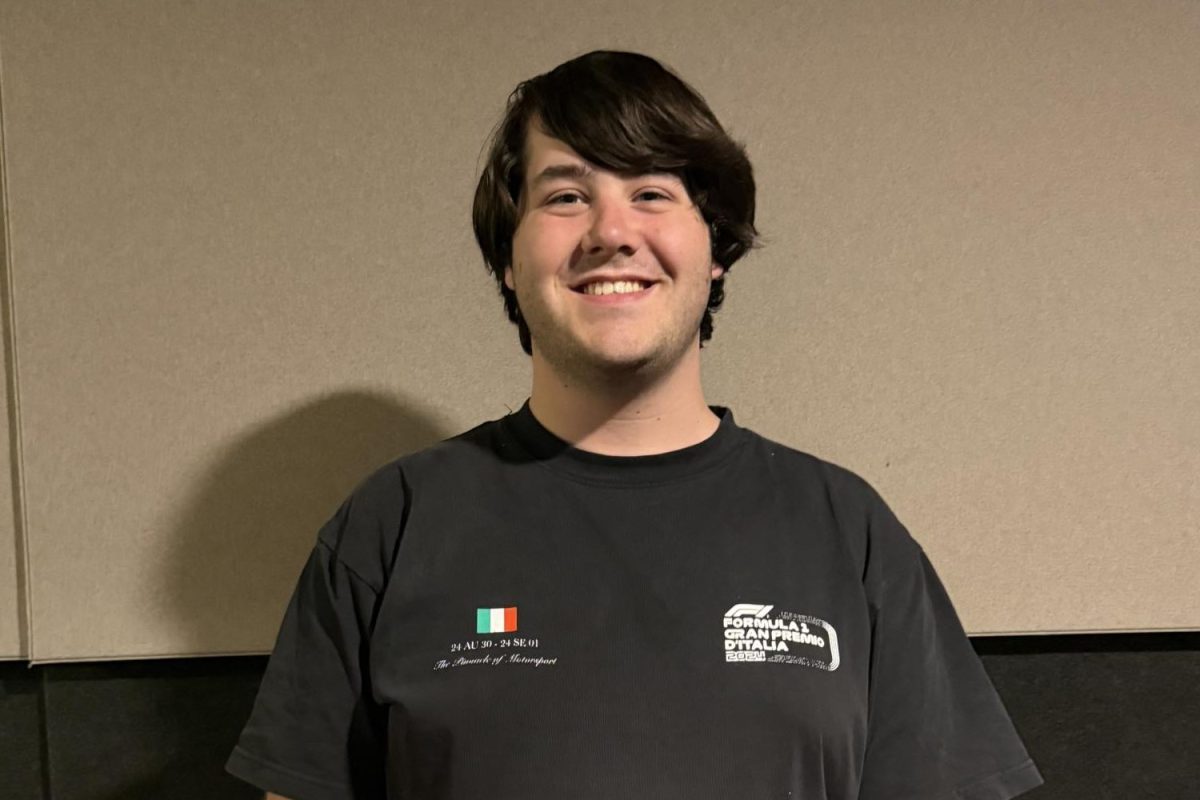
While audiences follow actors across the stage, senior theatrical technician Charlie Bryant focuses on what they don’t notice: the timing of cues and adjustments that make a production look effortless. “To an audience, a show will look almost flawless,” he explained. “But that’s the result of a lot of work that goes on behind the scenes.”
Bryant’s introduction to technical theater began early in his education. He traces it back to elementary school in Seattle, Washington, where he participated in a production of “Alice in Wonderland.” After coming to Poly in sixth grade, he participated in behind-the-scenes work for the first time on “Once Upon a Mattress” in his eighth-grade year. That early exposure gave him a foundation, but it wasn’t until high school that technical theater became something much more prominent in his life.
From the beginning of his freshman year, Bryant was a consistent presence in Poly productions. He worked on musicals including “Zombie Prom,” “Cinderella” and “Mamma Mia,” the spring musicals in 2023, 2024 and 2025, respectively, and is currently working on this year’s spring musical “The Drowsy Chaperone.” Outside of school, Bryant expanded his experience at Lineage Performing Arts Center, where he worked as a lightboard operator for a production of the musical “Rent.” “I was in charge of managing the lights during the production and making sure that all the light changes were on cue,” he explained. Bryant has also contributed to various plays throughout the years, one of which was “Unsex Me”, a student-written production by junior Sophie Converse and sophomore Amira Shamsi, where he served as a lighting designer.
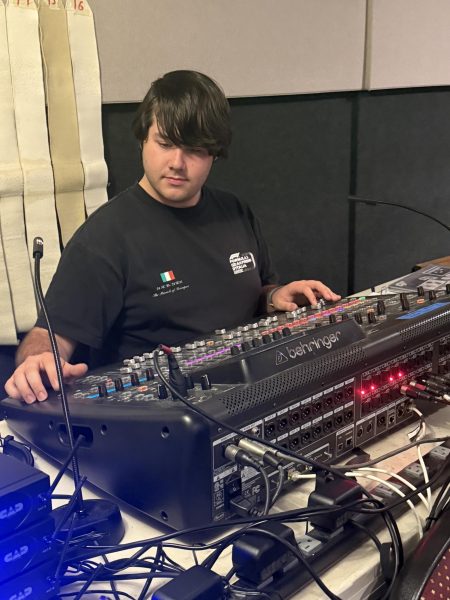
In his role as the crew’s lighting and sound designer, Bryant is responsible for mixing microphones, the art of activating and balancing actors’ microphone volume, minimizing feedback and reducing ambient noise. “It’s a job that requires constant attention,” he said. “You have to respond to how the actors are feeling that night, how loudly or quietly they’re able to sing.”
That unpredictability is exactly what draws him to sound design. Unlike other aspects of production that can be fully programmed in advance, sound requires real-time decision-making. Bryant described, “It’s a very on-your-feet activity.” While he has experience in both lighting and sound, this responsiveness makes sound design his preferred focus.
Every role in technical theater is integral to a smooth production, which is largely student-run. Upper School Performing Arts teachers Andrew Villaverde and Richard Sherrell act as mentors, but much of the responsibility falls on students, especially during technical week. Villaverde has seen Bryant grow within this environment over the years. “He was always engaged, interested and capable,” he said. As Bryant took on more responsibility, he became someone Villaverde could rely on to lead. Villaverde described how Bryant helps guide newer students during productions: “He’s always been very good at including everyone and making sure that they are on board with the plan.”
That reliability is especially evident in Bryant’s work this year. As the primary sound designer, he has taken on a more structured approach to his role. One of his initiatives has been organizing individual microphone check sessions with actors. He shared, “I’ve started having actors come in during their free time to do an individual mic check.” By doing this, he can better understand how each performer interacts with their microphone and adjust accordingly. “I’m expanding it more this year, and I hope that it’ll pay off.”
He has also worked on programming soundboard scenes, a process that allows multiple microphones to be adjusted simultaneously with a single cue. While common in professional theater, it is not typically implemented at the high school level. Villaverde noted the significance of this effort. “I don’t think we ever thought it was something we’d be able to do at the high school level,” he mentioned. “But because of the work that Charlie put into it, it really is a manageable task.” He added that it is something the department plans to continue in future productions.
Bryant emphasizes that he keeps coming back to technical theater as a creative outlet. “It’s definitely a cathartic experience,” he said. After putting in long hours and navigating challenges, opening night offers a sense of release. “When you open, and it just goes smoothly, it’s one of the greatest experiences ever.”
Looking ahead, Bryant is set to continue his education at Trinity College in Dublin, Ireland, double-majoring in Linguistics and Middle Eastern Jewish and Islamic civilizations. Along with his majors, he plans to continue pursuing technical theater. He shared, “It’s definitely something that I won’t be able to escape.”
After years in the program, Bryant’s work has shaped how shows are run, from team dynamics to technical systems. As Villaverde put it, “It’s been six years, it’s a long time to get to know somebody. We’ll definitely feel his loss when he goes.”