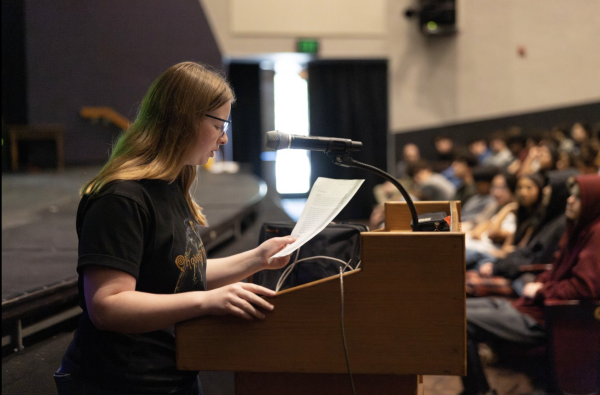
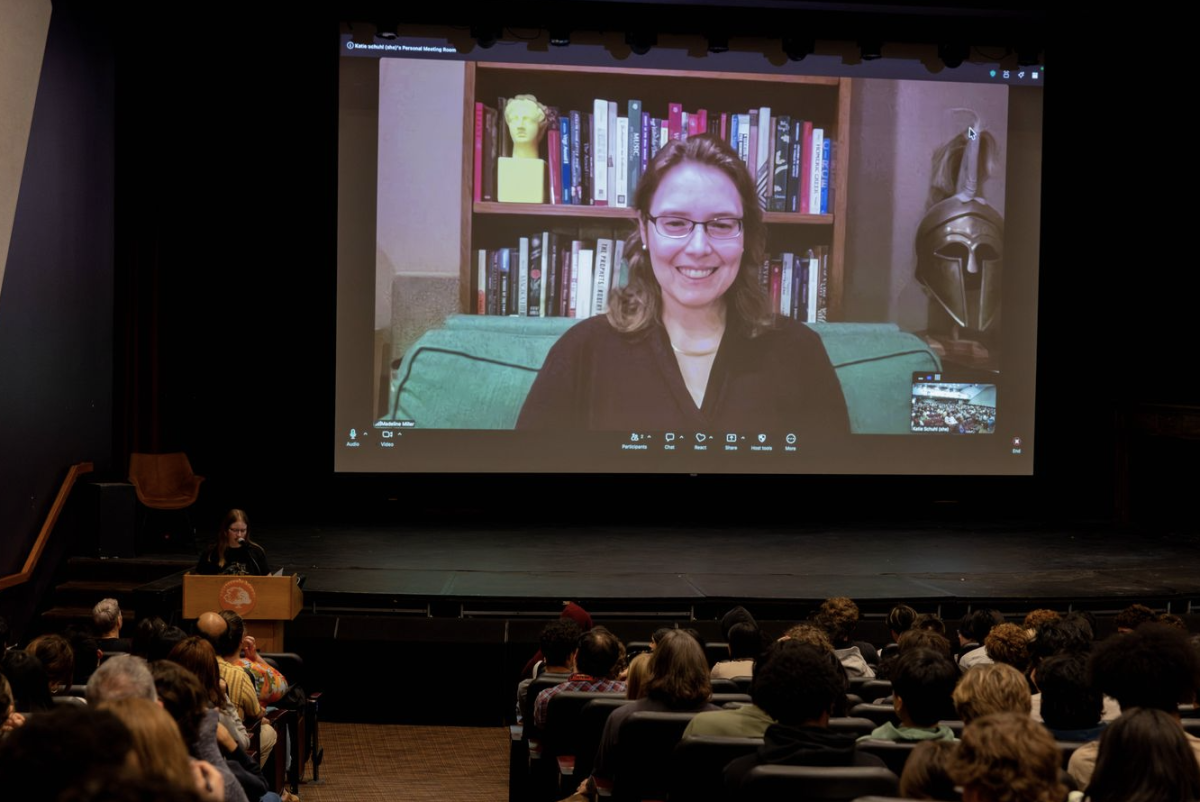

















On Tuesday, March 3, American author Madeline Miller spoke to the Poly Upper School community in Garland Theater via Zoom. Miller is the author of numerous novels, including “The Song of Achilles,” the winner of the 2012 Orange Prize for Fiction, and “Circe,” which won the Goodreads Choice Award for Best Fantasy. Both novels drew inspiration from Greek mythology, reinterpreting well-known myths through character-focused narratives.
The event was hosted by the English, history and world languages departments, as well as through the Upper School Library and the Senatus Populusque Romanus (SPQR), Poly’s student-run Latin club.Senior Bridget Bickell and sophomore Asher Bianco, both SPQR members, along with Latin teacher Kathleen Schuhl, interviewed Miller.
“I was excited to host Madeline Miller for an assembly because I know she has a large and passionate fan base, and I believe that this is primarily due to her ability to bring ancient epics like “The Odyssey” and “The Iliad” into a modern context while still staying true to their essence,” shared Bickell. “I respect her a lot for creating an approachable introduction for a new generation of people who have never considered studying Greek myths.”
Miller spoke about how her studies of classics, along with her experience in directing Shakespearean dramas, shaped her perspective on storytelling. She emphasized the importance of finding a supportive community of writers to reflect and share work with, and not to focus so heavily on the name of the institutions they attend. Reflecting on her own career, she described the level of dedication required to complete her novels, each of which took years to write and publish, and the persistence necessary to complete long creative projects.
Miller explained that she began studying classics in high school before pursuing it in college; she initially approached Greek and Roman mythology separately before experiencing what she described as a “clicking moment.” She realized that she could unite her academic interests with her background in directing plays and her love of dramatic storytelling, including the inspiration she drew from her study of Shakespearean Roman-inspired plays.
Miller’s visit also explained how to handle some of the inappropriate portions of classical literature while still maintaining the plot points and structure of the original myth.
“I have students who love her and see her as a role model. I think what stood out to me was when she started talking about having a push-pull experience with Greek mythology, ‘cause I remember that when I was a kid too. I read these myths and I loved them, but at a certain point, they were [problematic], and that was how I felt about them,” explained Schuhl. “In so many ways, they’re problematic. And yet, they have such beauty and power to them at the same time, that both of those things could exist at the same time. That was really helpful for me to learn.”
“I think listening to Madeline Miller talk to us as a community made me want to reread those books again based on how much experience [she had] in her research and her passion in mythology,” said English teacher Elsie Dang. “I felt like her passion for mythology and the intense research [behind] her creative process reinvigorated and made me want to revisit her book someday.
“I really love Madeline Miller because she’s such an amazing author in the sense that she really understands the characters that she’s trying to write about, and she’s able to humanize them in a modern way to help current day audiences really understand who they are as characters, and not just as symbols of traits that they portray in their original storytelling and stories,” explained sophomore and SPQR member Asher Bianco.
Miller’s visit served as a reminder that the stories of the ancient world remain part of an ongoing literary tradition, one that continues to be retold by writers and readers today. She emphasized that high school students should have a diverse range of interests, even if there isn’t a clear path forward, explaining that these different passions often intertwine over time.