














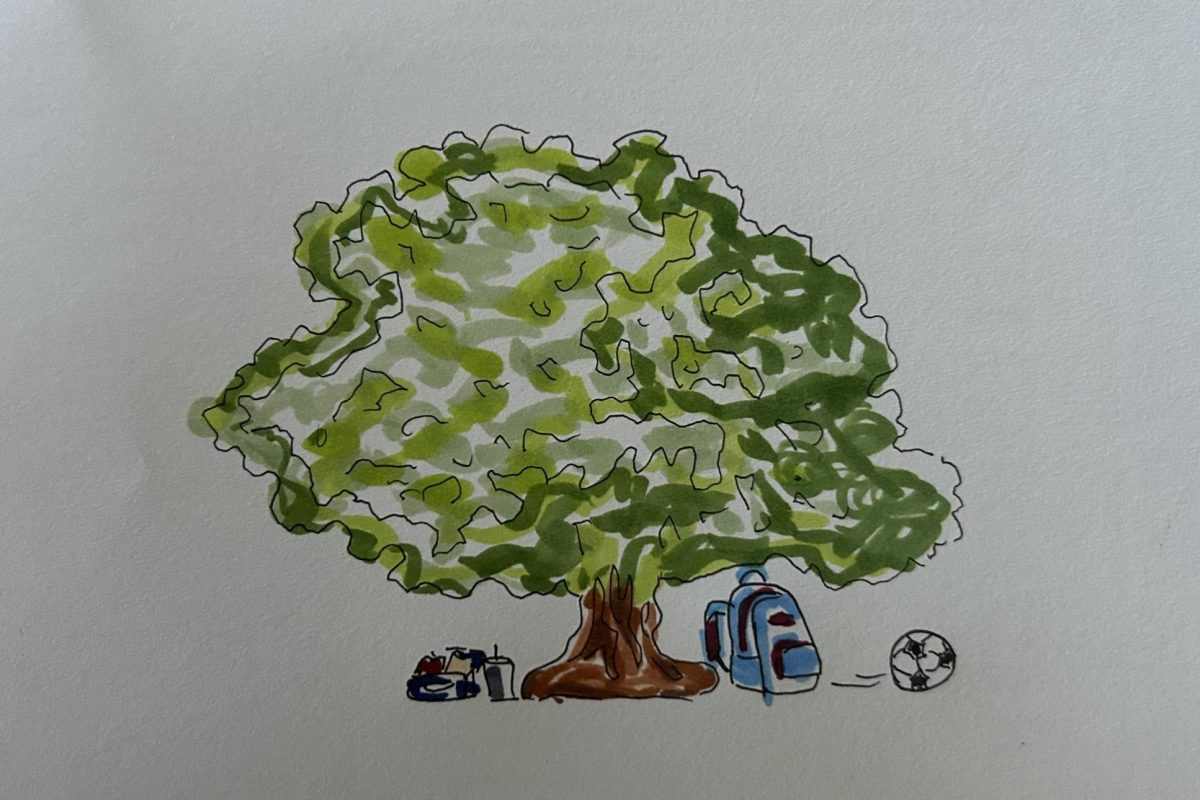
As I spent my first day of freshman year frantically searching for my enameling class in Boswell, an upperclassman told me, “It’s the one near the giant oak tree.” Although I only got to witness the tree for one year before it was cut down over winter break this year, the landmark set the backdrop for my very first Oak Leaves Dance and many outdoor assemblies and PASC Fifth Quarters.
This twisty tree, however, wasn’t just a campus cornerstone. A correspondence between former Headmaster Willis Stork and the California Historical Society in 1972 revealed that the Poly oak tree served an important purpose for the native Gabrielino-Tongva people. In fact, before becoming the school logo or framing McWilliams courtyard, the oak tree was used as a marker. “This oak tree, when very young, had been bent down to the earth as a direction marker for Indians to bring their grain to the Old Mill,” commented Headmaster Stork.
Although Poly’s archives do not explicitly specify whether the tree referred to in this popular Tongva story was the one on Poly’s grounds or a different tree on Oak Grove Avenue, it’s clear how much Poly valued the giant oak tree as a source of shade, a logo and a place to gather.
“It was always there, and now it isn’t,” commented Poly alumni and Upper School Film teacher Adam Feldmeth ‘04. He, along with other faculty members who recalled the tree, pointed out its distinction on campus and appreciated the fact that it far pre-dated the institution. Despite frequent changes and additions to the campus in recent years, such as the introduction of the sign-out portal, the installation of campus security gates, and the renovation of Arden lawn, the oak tree remained a symbol of the school’s longstanding history.
“The revitalization of Arden as a woodland area is now counterbalanced by the unfortunate need to remove Poly’s beloved oak,” said Feldmeth when discussing the absence of the tree, which overlooked his office and which he recalls gathering under with friends and classmates during his time as a student.
If there’s one thing Pasadena is serious about, it’s the trees: The city has several ordinances regarding the removal of native and protected trees. Poly’s oak tree, however, has a reason for its removal because it posed a safety risk for students and faculty on campus. “This tree likely has multiple active diseases around its lower trunk that are causing its decline, and the decline is progressive and will eventually lead to death or failure of the tree,” said the landscape designer of Arden, Michele Antenorcruz.
Sometimes the most significant things in life are only recognized in their absence. Many of us who attend Poly don’t actively consider all the ways this school envelops our lives and how we will miss it when we leave. The oak wasn’t just a tree, but an enduring symbol of the Poly community, and a way for us to remember that Poly is a community made up of current students and those who have long graduated.