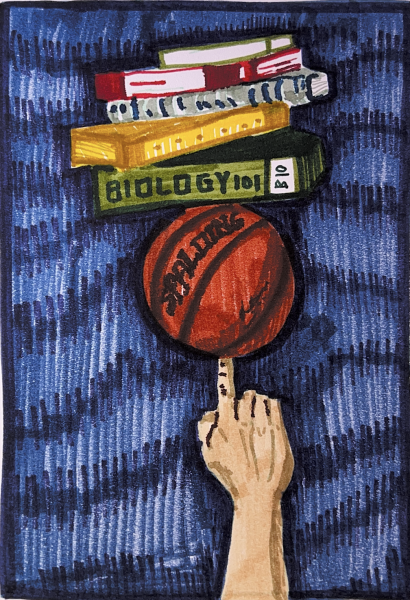
When the final school bell rings at 3:15 pm, students bid farewell to Poly’s classrooms, but for many, the day is far from over. As backpacks are swapped for jerseys, balancing athletics and academics is a daily reality that requires discipline, sacrifice and determination. Poly prides itself on offering 23 different high school sports to participate in regardless of skill level, providing students manifold opportunities to not only compete for success but also embark on a journey of personal exploration.
One of the greatest values of being a student-athlete is the emphasis on teamwork. Both practices and games teach collaboration and communication skills as athletes rely on one another to succeed. Even in individual sports, encouragement and support still remain essential. These experiences cultivate relationships grounded in mutual trust, demonstrating the importance of striving towards a shared goal.
Highlighting the power of team camaraderie, senior girls water polo captain Georgie Collister shared, “I got incredibly close with my teammates and am still great friends with many who have graduated, and they come and watch our games sometimes when they’re back home from college.”
Fortifying a cohesive team dynamic, frequent practices, often two hours long and five days a week, foster a sense of community fundamentally built upon collective dedication to pursue greatness. Over time, this consistent commitment evolves into a powerful sense of achievement as athletes witness their own personal growth.
Despite these benefits, the demands of being a student-athlete are no easy feat. With daily practices and matches ending as the sky seeps into the night’s dark embrace, many athletes must develop strong study skills to complete their assignments while persevering through physical exhaustion.
“Some valuable lessons I have learned so far would be to always plan ahead and try to get as much sleep as possible,” noted sophomore basketball player Devan Truong.
Although participating in athletic activities after a long day of school may seem cumbersome, it is the challenges that truly shape student-athletes the most. Early dismissals for matches may interfere with academics, forcing students to take proactive measures in communicating with teachers to ensure they keep up with their class workload. Managing a packed schedule forges time management and responsibility as students discover their own strategies to prioritize their commitments and push through fatigue while maintaining focus in the classroom.
“I’ve learned that balance isn’t about being perfect, it’s about listening to yourself, asking for help and trusting your teammates to support you when things feel overwhelming,” senior girls soccer captain Mariana Gomez stated.
Faculty members serving as coaches face a similar balancing act of their own. Like student-athletes, faculty coaches must endure long days while tasked with planning curriculum and grading assignments. Despite the demanding schedule, these educators serve a crucial role in guiding students both academically and athletically.
Fencing head coach L. Holmgren asserted, “I’m a big believer that physical activity helps you as students. Healthy mind, healthy body, and so, part of coaching is that piece of physical activity. It’s discipline. It’s pushing through hard things.”
Poly’s student and faculty community has demonstrated they can achieve both success on the field and in the classroom, a testament to unwavering resilience and commitment. Although simultaneously juggling academics and athletics certainly isn’t easy, the lessons and relationships established with this dual identity last far longer than any mere season.
Collister reflected, “I’m sure there have been times when I wished I could have gone home when the sun was still up or that I wouldn’t have to miss a class for a game, but I know that if I went back in time and had to do it all over again, I would still choose to do water polo and swim.”