Georgie Collister
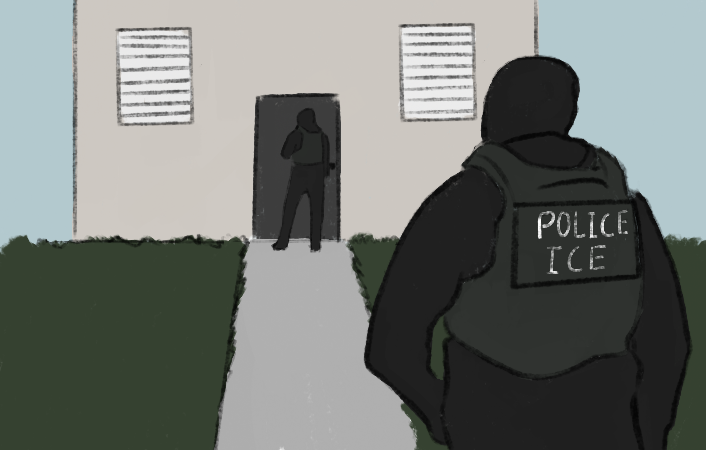
In 2025, U.S. Immigration and Customs Enforcement (ICE) intensified efforts to arrest suspected undocumented individuals across the country, particularly targeting people of Latino/Latinx origin. ICE has arrested over more than 1000 suspected undocumented immigrants per day. Several of the arrestees were U.S. citizens, and about 70% of them had never been convicted of a crime, according to the think tank Third Way.
The numbers have grown from roughly 200 per day in early January 2025, before President Trump’s inauguration. As reported by the American Immigration Council, the total number of people held in immigration detention rose 75% this year, from 40,000 in January to 66,000 in December, the highest ever recorded. According to one estimate by the Prison Policy Initiative, from Monday, Jan. 20, 2025, to Wednesday, Oct. 15, 2025, ICE arrested 19,914 individuals in California, a 254% increase from 2024. In June of 2025, the escalation of large-scale raids in Los Angeles led to widespread protests.
The increase stems from the Trump administration’s changes to the immigration system. On his first day in office for his second term, Trump issued an executive order that overrode Biden’s immigration priorities and allowed ICE more autonomy.
The order states, “The Secretary of Homeland Security shall take all appropriate action to … protect the public safety and national security interests of the American people, including by ensuring the successful enforcement of final orders of removal.”
The administration also made it more difficult to make claims in immigration court, fired immigration judges who opposed mass deportation, and gave ICE agents quotas and new requirements to detain most people they suspected of lacking U.S. citizenship.
The raids have intensified both locally, with protests over ICE agents staying in Pasadena hotels during the summer, and nationally, with fatal shootings like those of U.S. citizens Renée Good and Alex Pretti in Minneapolis. Poly students and faculty alike have shared their concerns amid the escalation.
Senior Allison Nieves, a leader of the student affinity group Latines Unides, noted, “I never thought I would see ICE agents in the streets of Pasadena. I grew up in East LA, so I hear about one new neighbor or one person I knew from Church get taken every week at least, but it was a little crazier knowing that it was happening in Pasadena.”
Latines Unides has reaffirmed Hispanic peoples’ important role in our community with events like the Hispanic Heritage Month Assembly in October, which featured student performances in Garland Theater and food out on McWilliam’s courtyard.
Another leader of the group, senior Alejandro Kohn Rabassa, said, “I saw the leadership role at Latines Unides as an opportunity to bridge divides and build common understanding. You try to show people that there are things that connect you as humans beyond culture, things that you can enjoy together, like food [and] music. Recognizing that everybody has things that unify them and commonalities is the first step to welcoming them or building an inclusive space.”
Upper School English Teacher Alexander Jimenez, one of the faculty advisors to Latines Unides, provided insight on how Poly’s administration is handling the raids: “Dr. Mares-Tamayo, Mr. Melgoza, and Ms. Cardillo, at the beginning of the year, provided Latines Unides and other community members with quarterly counseling. They partnered with a trained mental health professional to come in and have low stakes, communal discussions about trauma and any anxiety and fear connected to ICE raids.”
“I do think that younger people take cues from older people, and I think if the adults are silent, then the students might feel tacitly coerced into silence as well,” Jimenez continued. “I think faculty should engage in more discussions as a community of adults so that they can then reenter the community in whatever position they hold and ensure that our students feel supported [and] cared for. It’s also our job as teachers to provide students a space to think critically about these ideas and these topics.”