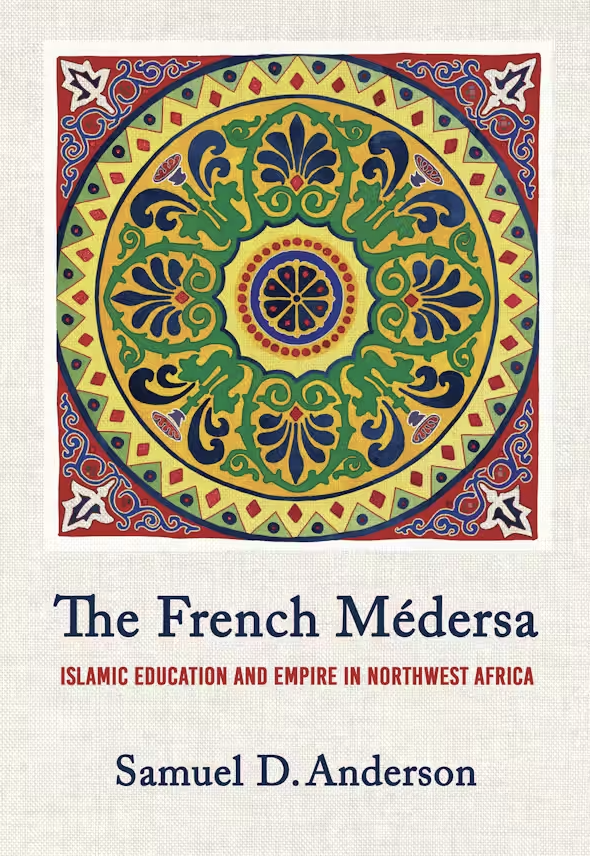
Upper School History teacher Samuel Anderson’s first book, “The French Médersa: Islamic Education and Empire in Northwest Africa,” is set to release on Jan. 15, 2026.
A revised version of Anderson’s PhD dissertation, the book discusses ideas of the intertwinement between France and Islam as perpetuated by the Médersa, schools that combined French and Islamic curricula in order to create connections between the regions that made North and West Africa more easily controlled by France. Anderson’s central argument revolves around the idea that Franco-Muslim education stood at the center of both the French Empire’s history and the evolution of Islamic education across northwest Africa.
“I was able to travel for research in Algeria, Senegal, Mauritania, Morocco, and France, which was such a rare and amazing opportunity,” Anderson shared. “Working in archives was really interesting, as was meeting with local historians and other people in each of those countries.”
Particularly during his time in Mauritania, Anderson forged global connections that supported his writing and research. Although access to the historical archives, a crucial component of his work, was sometimes difficult, he ultimately managed to overcome these challenges.
“In Senegal, my research trip overlapped with a time when they were actually moving the archives from one building to another,” explained Anderson. “But that was actually a good thing. During that time, I went to Mauritania, and I found some sources that I wouldn’t have seen otherwise because of that obstacle.”
Sophomore Kylie Cameron, one of Anderson’s Perspectives on World History students, shared, “I am very excited to read Dr. Anderson’s book because I think it is a topic most people don’t know about, including me, so I am excited to learn. Also, he is a very good teacher and his classes are always interesting so I think his book will be the same.”
Anderson also reflected on how this book has influenced his own development as a teacher and historian.
“I think one big takeaway for me is emphasizing connections across space and time,” added Anderson. “I hope that my research and writing experience translates into how I teach the research and writing process to students – that it takes a long time[.] It can be frustrating and exciting and ultimately very rewarding.”